The Heavyweight Icon's Counterfeit Crisis
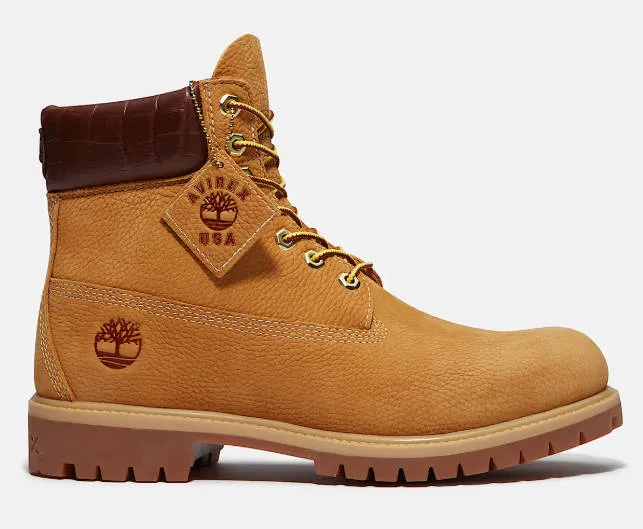
The Timberland 6-Inch Premium Boot (Style #10061) in the classic "Wheat" colorway is more than just footwear. Spanning generations from its NYC streetwear and hip-hop roots to seamlessly integrating into the 2026 Gorpcore and vintage workwear aesthetics, it is truly a global uniform.
Because of its undisputed reign, it is also one of the most heavily counterfeited boots on the planet. In 2026, modern replica factories have largely perfected the basic silhouette and that iconic wheat color. If you are only looking at the shoe through a phone screen, you can easily be scammed.
However, the soul of a Timberland boot lies in its "heavy-industry" manufacturing standards. An authentic Premium boot is built like a tank—it requires heavy-duty machinery for high-tension stitching, expensive waterproof nubuck, and solid metal hardware. Counterfeiters, driven by profit margins, inevitably cut corners on these invisible structural and sensory details.
This updated 2026 guide will teach you how to conduct a thorough structural audit—feeling the weight, checking the stitch tension, and probing the inner hardware—to easily expose even the best replicas.
The 30-Second Authenticity Checklist
Shopping online on platforms like Depop, eBay, or browsing a local vintage store? Run through this rapid filter. If the boot fails any of these checks, you are likely holding a fake:
-
🚩 The Weight Test: Does the boot feel surprisingly light? (Authentic Premium boots are incredibly heavy and dense. Fakes frequently feel like hollow styrofoam).
-
🚩 The "Quad" Stitch: Look at the curved stitching on the side panels. Are there four distinct, perfectly parallel lines? (Fakes often have only 3 lines, or the 4 lines overlap, wander, and look messy at the corners).
-
🚩 The Inner Eyelet Scratch Test: Put your hand inside the boot and feel the back of the lace eyelets. Does it feel sharp, like a split metal flower? (Authentic inner eyelets are smoothly rolled and will never snag your socks or scratch your skin).
-
🚩 The Burnished Tree Logo: Is the tree logo on the outer ankle just lightly stamped on, bearing the exact same color as the surrounding leather? (Authentic logos are heat-pressed, creating a "burnished" or slightly charred effect, making the logo noticeably darker brown than the rest of the boot).
-
🚩 The Insole Geometry Test: Pull the insole out of the boot. Is the bottom completely flat and made of cheap white foam? (Authentic Premium 10061 boots feature thick Anti-Fatigue insoles with a highly distinct, 3D geometric cone pattern underneath, usually in a bright orange/red color).
Want to know exactly how to feel for these details? Keep reading for our comprehensive sensory breakdown.
Deep Dive: The 5 Ultimate Signs of Authenticity
Sign 1: The Nubuck Leather & The Soulful "Quad-Stitch"
The durability of a Timberland boot relies entirely on its leather quality and stitch strength. Because you might not have an authentic pair next to you for comparison, you must rely on the "brush test" and stitch counting.
|
Feature |
✅ Authentic Timberland (Premium) |
❌ Counterfeit (Fake) |
|---|---|---|
|
The Material (Waterproof Nubuck) |
Uses incredibly thick, premium waterproof Nubuck. It has a buttery feel and a very fine, subtle "nap" (short raised fibers) on the surface. |
Often uses cheap, stiff suede or synthetic microfiber. It feels like rough cardboard or completely lacks the velvety nap, looking flat and dead. |
|
The Four-Row Stitching (Crucial) |
Timberland’s hallmark of heavy-duty craftsmanship. The side panels feature four rows of heavy nylon stitching that are perfectly parallel and evenly spaced. |
Fake factories use standard sewing machines that cannot handle the leather's thickness. This results in wandering stitches, uneven spacing, or threads overlapping and bunching up at the sharp curves. |
|
Waterproof Sealing |
Authentic pairs feature invisible silicone sealing inside the leather seams to ensure waterproofing. |
Seams often have visible gaps or show sloppy, yellowing glue spilling out from the edges. |
🔍 The Sensory Pro-Tip: Run your thumb firmly across the yellow leather. Authentic premium nubuck will show a slight color shift where you brushed it (because the tiny hairs lay down in a different direction). Fake synthetic leather will remain completely static and feel like smooth, stiff plastic or rough sandpaper. Furthermore, look closely at the Quad-Stitch: authentic nylon threads are incredibly thick and sit above the leather, whereas fake threads are thin and often sink completely into the cheap material.
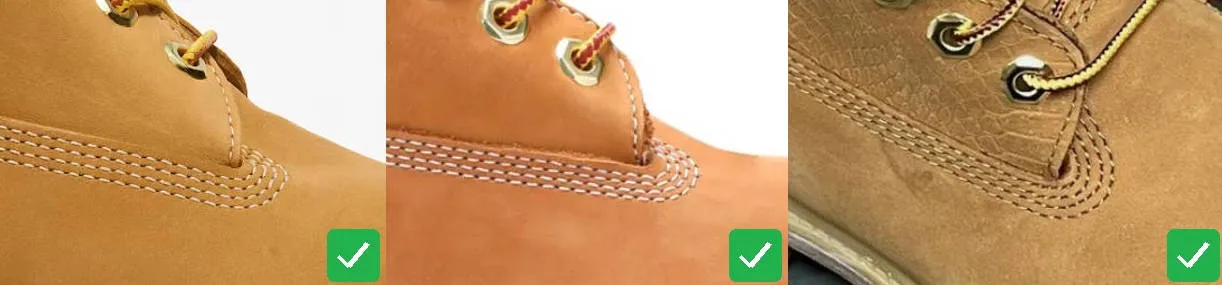
Caption: 📸 Authentic Reference Standard: Lock your eyes on those four rows of stitching. On an authentic Premium boot, these heavy nylon lines are perfectly parallel and evenly spaced, even around the tightest curves. Notice the rich, buttery texture of the premium nubuck leather. Replicas frequently fail here, showing disastrous overlapping stitches and cardboard-like leather.
Sign 2: The Tree Logo's "Burnished" Effect
The iconic tree logo stamped on the lateral heel is not just a graphic; the way it is applied is a major authentication point that fakes cannot easily replicate without expensive heated molds.
|
Feature |
✅ Authentic Timberland (Premium) |
❌ Counterfeit (Fake) |
|---|---|---|
|
Embossing Depth & Clarity |
The stamping is incredibly deep, crisp, and sharp. Every branch, leaf, and the tiny circular |
The stamping is shallow, appearing to float on the surface. The edges of the branches are blurry, and the tiny |
|
The "Burnished" Effect (Core Tell) |
Authentic factories use a highly heated press that slightly carbonizes the nubuck. Therefore, the logo is noticeably darker (a deep tan/brown) than the surrounding yellow leather. |
Fakes typically use a cold press to save on energy and mold costs. The resulting logo is the exact same color as the rest of the boot, completely lacking that premium burned contrast. |
🔍 The Sensory Pro-Tip: Close your eyes and run your fingernail over the tree logo. On an authentic pair, your nail will physically dip into the deep, clean grooves of the branches. On a replica, the logo feels almost flush with the leather. Additionally, the darker, "burnished" area on an authentic boot will actually feel slightly smoother and harder than the surrounding fuzzy nubuck due to the extreme heat-press process.
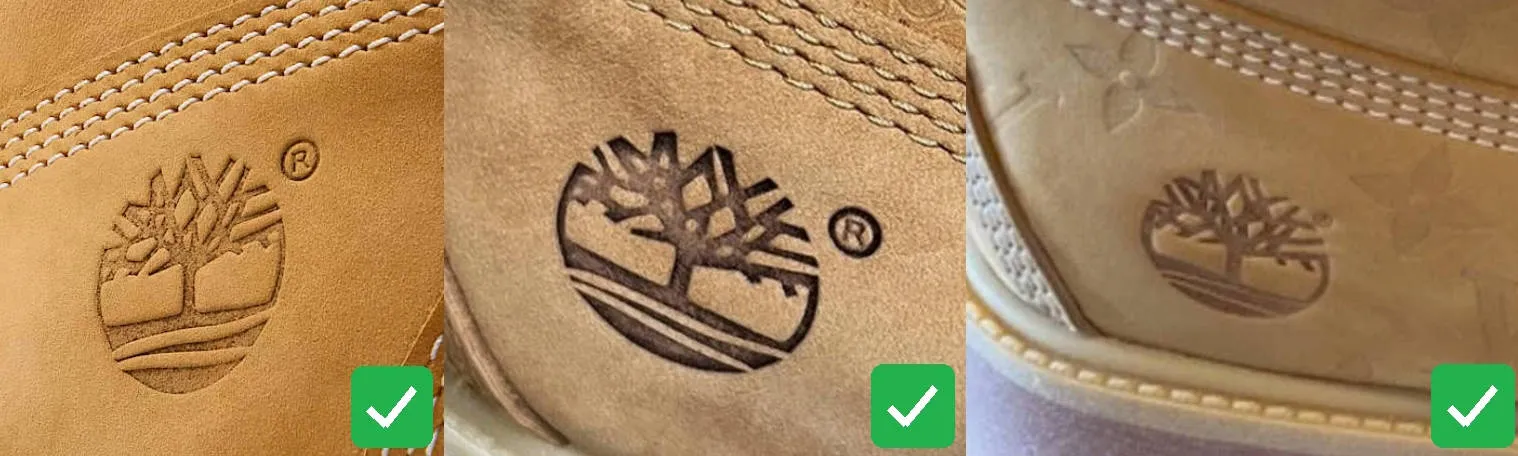
Caption: 📸 Authentic Reference Standard: Observe the Tree Logo closely. Not only is the embossing deep and sharp, but it also features the signature "burnished" look. Because it is heat-pressed, the logo area turns a darker brown, contrasting beautifully with the bright wheat leather. Cold-pressed fakes lack this color difference entirely.
Sign 3: The Hardware (Inner Eyelets & Taslan Laces)
Hardware is a counterfeiter's favorite place to hide cheap materials. Many super-fakes look great on the outside, but the moment you probe the inside of the boot, their cover is blown.
|
Feature |
✅ Authentic Timberland (Premium) |
❌ Counterfeit (Fake) |
|---|---|---|
|
Outer Eyelets |
Classic hexagonal, rust-proof brass eyelets. The hexagonal shape is crisp, and they are deeply and securely embedded into the leather. |
Uses thin, cheap alloys. They often aren't perfectly hexagonal (looking slightly rounded), and the paint chips or rusts quickly. |
|
The Inner Eyelet Test (Ultimate Tell) |
Reach inside the boot and feel the back of the lace holes. Authentic inner eyelets are smoothly rolled and rounded off. They will never scratch you. |
To save on expensive clamping machinery, fakes leave the inside of the eyelet looking like a split metallic flower (sharp metal petals). They will snag your socks and scratch your foot. |
|
Taslan Laces |
The signature two-tone laces are made of tightly braided, extremely durable Taslan nylon. They resist stretching and pilling. |
Uses cheap, fluffy cotton blends. They stretch out completely when pulled tightly and pill up with fuzz after a few wears. |
🔍 The Sensory Pro-Tip: The "Pinch and Pull" lace test. Take an authentic Taslan lace between your fingers and try to pull it apart or stretch it—it will feel rigid, almost like thin mountain-climbing rope, with zero elasticity. Fake cotton laces will stretch out like a rubber band and feel soft and hollow inside.
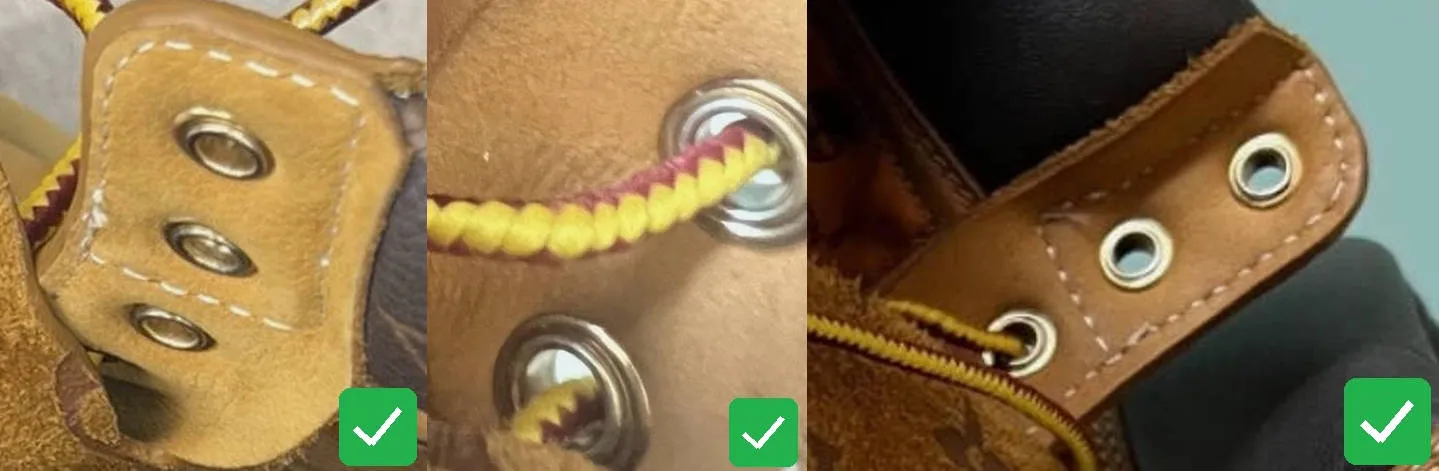
Caption: 📸 Authentic Reference Standard: This is the ultimate secret weapon for authenticating Timbs—the inner eyelet test. Genuine Timberland hardware is perfectly rolled and smoothed out, even on the invisible interior. If your fingers feel sharp, split metal claws inside the boot, you are holding a cheap fake.
Sign 4: Outsole Density & Inner Anti-Fatigue Tech
The Premium 6-Inch boot is notoriously heavy, but it remains comfortable during long wear due to proprietary internal tech. Fakes only copy the outer shell, leaving the inside completely hollow to save on shipping weight.
|
Feature |
✅ Authentic Timberland (Premium) |
❌ Counterfeit (Fake) |
|---|---|---|
|
Rubber Outsole Density |
True, thick rubber. The sole is incredibly dense, rigid, and slightly translucent (often described as a deep honey color). |
Many fake soles are hollowed out inside and filled with cheap EVA foam. They are often aggressively yellow, highly opaque, and look like cheap plastic. |
|
Anti-Fatigue Insole (The Geometric Test) |
Remove the insole. Modern Premium boots feature proprietary Anti-Fatigue technology. The underside of the insole must have a distinct, molded 3D geometric/hexagonal cone pattern (usually bright orange, sometimes black). |
Features a completely flat, unsupportive piece of cheap white or grey foam with absolutely no structural geometry underneath. |
|
Midsole Shank |
Contains a hidden structural shank plate inside the sole for arch support. The boot is extremely difficult to fold in half. |
No shank plate. You can grab the toe and heel and bend the entire heavy boot in half with relative ease, proving the sole is weak. |
🔍 The Sensory Pro-Tip: The "Thumb Crush" test. Take your thumb and press as hard as you can against the side of the rubber heel block. An authentic Timberland heel is essentially a solid block of dense rubber; it will barely yield to your thumb. A fake heel, being hollow inside, will often feel squishy and compress under heavy thumb pressure.
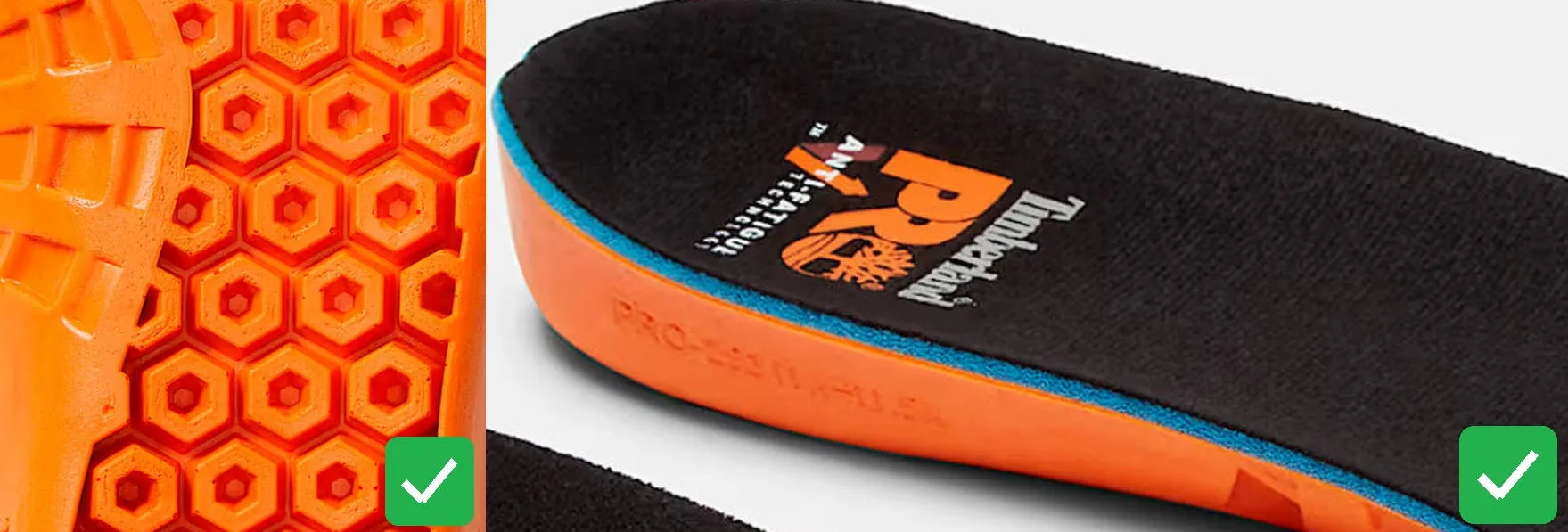
Caption: 📸 Authentic Reference Standard: The secret to the heavy boot's comfort. Pull out the insole and flip it over. Authentic Premium models feature proprietary Anti-Fatigue technology, instantly recognizable by its distinct, 3D molded geometric cone pattern (usually bright orange). Counterfeits skip this expensive tech entirely, providing a completely flat, useless piece of white foam.
Sign 5: Inner Tags, The Hangtag, and The UV Test
Details dictate authenticity. Counterfeiters mass-produce tags and boxes, often resulting in typographic errors and cheap materials that fail under advanced scrutiny.
|
Feature |
✅ Authentic Timberland (Premium) |
❌ Counterfeit (Fake) |
|---|---|---|
|
Inner Tongue Print |
Sizing, origin, and style codes are printed directly onto the material behind the tongue. The font must be crisp and perfectly legible. Authentic "Wheat" Premiums will always feature the style code |
Ink is smudged, blurry, bleeds into the fabric, or the style code randomly says |
|
The Leather Hangtag |
Comes with a square hangtag made of genuine, thick leather attached by a weighty, dark metal ball chain. |
Uses a cheap cardboard or thin polyurethane (PU) tag, often attached with a flimsy plastic zip-tie or a bright, cheap silver chain. |
|
The UV Light Test (Advanced) |
If you shine a UV (blacklight) flashlight over the boot, the authentic heavy-duty nylon stitching remains relatively dull. |
Fake factories frequently use cheap polyester threads heavily treated with chemical brighteners. Under UV light, the fake stitching will glow like bright blue neon lights. |
🔍 The Sensory Pro-Tip: The 'Bend and Smell' test. Grab the square hangtag attached to the boot. An authentic leather hangtag will bend flexibly without creasing and has a distinct genuine leather smell. A fake PU or cardboard tag will feel rigid, might crease permanently if bent, and will either smell like cheap chemicals or nothing at all. Additionally, feel the metal ball chain; it should have a noticeable, solid weight to it.
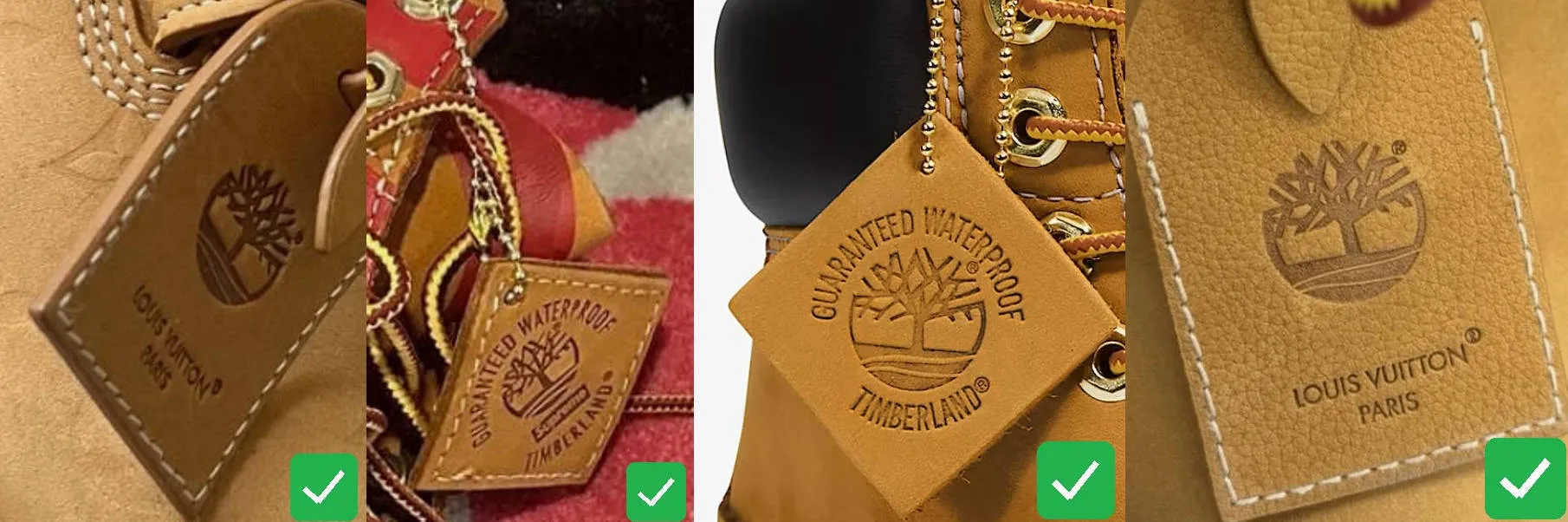
Caption: 📸 Authentic Reference Standard: Pay attention to the accessories. An authentic pair comes with a thick, genuine leather hangtag connected by a weighty, dark metal ball chain. Counterfeiters routinely cut costs here, using flimsy cardboard or polyurethane (PU) tags attached with cheap plastic zip-ties or bright silver chains.
The Expanded Timberland Matrix: Premium vs. Basic & High-End Collaborations
With Timberland's massive resurgence in streetwear and high-fashion spaces leading up to 2026, the 6-Inch boot has become a canvas for major designers.
A crucial rule of authentication: Do not misapply the standard "Premium 10061" rules to high-end collaborations, and do not mistake an authentic "Basic" boot for a fake "Premium." You must know exactly what model you are inspecting.
The Baseline: Premium (10061) vs. Basic (10066)
Timberland officially produces a more affordable "Basic" version of the 6-inch boot. If you paid top dollar for a boot claiming to be Premium, ensure it has the flagship features below.
|
Feature |
Premium (Style 10061 - Flagship) |
Basic (Style 10066 - Budget Tier) |
|---|---|---|
|
Retail Price (Approx) |
$198 - $210+ USD |
$140 - $160 USD |
|
The Padded Collar |
The black padded ring at the top is wrapped in luxurious, genuine glove leather. |
The black padded ring is wrapped in standard synthetic/fabric material. |
|
Insole Technology |
Features the thick, geometrically molded Anti-Fatigue technology insole. |
Features a standard, flat foam insole. |
|
Inner Lining |
The entire interior of the boot (tongue back, side walls) is fully lined with smooth, premium leather. |
The interior features a standard canvas/fabric lining, not full leather. |
|
Internal Shank |
Contains a fiberglass shank for arch support; the boot is very difficult to bend. |
May lack the rigid structural shank; the sole feels more flexible. |
(Note: If you paid $200 for a boot claiming to be the Premium 10061, but it lacks the full leather lining and the orange anti-fatigue insole, you either bought a replica, or a scammer is trying to sell you the cheaper Basic model at a Premium markup).
The Collaboration Matrix: Designer Tells & Fake Flaws
Counterfeiters heavily target limited releases due to their massive resale premiums. While collaborations often change the materials or hardware (ditching the standard nubuck or brass eyelets), replica factories frequently make specific, fatal errors when trying to copy these unique designer details.
Use this matrix to spot the unique tells of high-end Timberland collaborations:
|
Collaboration |
Key Design Signatures (The Authentic Details) |
🚨 The Fatal Fake Flaw (What Replicas Get Wrong) |
|---|---|---|
|
Louis Vuitton |
Features LV Monogram debossed leather, custom heavy LV metallic hardware, premium LV leather tongue tags, and high-end packaging. |
The Depth Flaw: The Monogram debossing is often far too shallow, looking blurry or barely visible. Furthermore, fake LV hardware feels light, plasticky, and the gold paint chips off rapidly. |
|
Supreme |
Frequently uses bold, all-over prints, custom metal lace dubraes (locks), and the iconic Supreme box logo deeply debossed on the leather. |
The Font & Print Flaw: The "Supreme" typography on the metal lace locks is often off-center or uses an incorrect font weight. On printed models, fake prints peel off easily, lacking proper leather adhesion. |
|
Jacquemus |
Known for exaggerated silhouettes, unique luxurious textures (like hair-on leather or shaggy suede), and minimalist metal Jacquemus branding. |
The Hardware Application: The subtle, minimalist metal Jacquemus logo applied to the side is frequently glued on crookedly, or you can see messy excess glue seeping out from under the metal letters on fakes. |
|
Off-White™ |
Signature Virgil Abloh design language: the famous zip-tie, quoted text (e.g., "SHOELACES"), industrial motifs, and often utilizes unique materials like crushed velour. |
The Zip-Tie & Text Flaw: The Off-White zip-tie is often the wrong shade of red/orange or feels overly brittle. The printed "SHOELACES" text on fakes frequently peels off after a single unlacing. |
|
Aimé Leon Dore (ALD) |
Focuses on ultra-premium leathers (often smooth finishes rather than nubuck), refined vintage colorways, and subtle ALD Queens crest branding. |
The Leather Quality Flaw: ALD collabs demand massive premiums because of the leather quality. Fakes completely fail the touch test; the leather feels incredibly stiff, plastic-like, and lacks the buttery softness of authentic ALD materials. |
|
Stüssy |
Frequently features heavy-duty side zippers, unique colored suedes, and embroidered or stamped Stüssy logos. |
The Zipper Action Flaw: Authentic pairs use heavy-duty, premium YKK zippers that glide smoothly. Fakes use cheap, unbranded zippers that snag constantly. The Stüssy embroidery often features messy, loose connecting threads. |
|
Awake NY |
Known for faux-snakeskin or crocodile leather textures and vibrant, unconventional colorways alongside Awake branding. |
The Texture Flaw: Authentic pairs use leather heavily embossed to feel like real scales. Fakes often just use a printed graphic on flat leather; if you run your finger over a fake, it feels completely smooth, lacking the 3D scale texture. |
|
Tommy Hilfiger |
Leans into a 90s aesthetic, featuring the classic red/white/blue Tommy flag, often with unique dual-branded tongues. |
The Embroidery Bleed Flaw: The iconic Tommy flag embroidery on fakes is often messy, with the red, white, and blue threads bleeding into each other or misaligned along the borders. |
|
BEAMS |
The Japanese retailer often utilizes genuine GORE-TEX waterproof membranes, unique lacing systems, and subtle Japanese market tagging. |
The GORE-TEX Lie: Fakes slap a GORE-TEX tag on the outside but lack the actual waterproof membrane inside. Fakes will fail a basic water test (water immediately soaks through the seams rather than beading off). |
|
White Mountaineering |
High-tech outdoor aesthetic featuring complex multi-paneling, blending premium suede with technical, ripstop fabrics. |
The Stitching Alignment Flaw: The complex, multi-layered panels require incredible sewing precision. Fake factories struggle here, resulting in crooked stitching lines, uneven margins, and technical fabrics that feel cheap and thin. |
V. FAQ & Addressing Misconceptions
"My boots say 'Made in Dominican Republic' or 'Made in China' on the tag. Are they fake?" No. This is a very common misconception. Timberland legally manufactures in multiple global facilities, including the Dominican Republic, China, Vietnam, Cambodia, and Bangladesh. The origin country is absolutely not an indicator of authenticity. Rely on the 5 structural signs in this guide instead.
"My nubuck upper got scuffed and showed water spots on the first day. Is this cheap fake leather?" Quite the opposite. While top-tier Nubuck is waterproof, its very fine, velvety surface nap is highly sensitive to physical friction. It will naturally show fingernail marks, scuffs, and temporary water spots. This is a characteristic of genuine premium hide. You simply use a suede eraser and brush to brush the nap back into place. If the boot is completely smooth and refuses to show any scuff marks, it's likely fake synthetic plastic.
"I bought a Supreme / Veneda Carter / Louis Vuitton collaboration. Why do the details look different?" High-end collaborations frequently break the standard rules. For example, the LV collab uses proprietary Monogram leather and hardware, while the Veneda Carter collabs famously use patent leather, completely ditching the nubuck. If you are authenticating a 2024-2026 designer collaboration, do not strictly apply the basic 10061 rules; you must research the specific design quirks of that exact release.
Where to Buy Authentic Timberland 6-Inch Boots
Because modern counterfeiters have perfected the basic visual silhouette and standard "Wheat" color, legit-checking photos online is extremely difficult. We strongly advise against buying Timberlands on peer-to-peer apps like Depop, Vinted, or Facebook Marketplace without rigorous authentication.
Primary Options (100% Guaranteed Authentic):
-
Official Timberland Boutiques & Website: The absolute safest method for general releases, granting you the full retail experience and manufacturer warranty.
-
Authorized Retailers: Major footwear and high-end department stores like Foot Locker, JD Sports, Nordstrom, and Dick's Sporting Goods are direct, verified partners of the brand.
Reputable Secondary / Resale Markets: If you are buying pre-loved boots or hunting for sold-out designer collaborations (like Louis Vuitton or Supreme), use platforms that provide physical, expert authentication:
-
eBay (Authenticity Guarantee): Highly recommended. Look for the blue "Authenticity Guarantee" checkmark on the listing, indicating the boots will be physically verified in-hand by independent experts before delivery.
-
StockX & GOAT: Both platforms act as middlemen and physically authenticate footwear. These are the industry standards for securing brand new ("Deadstock"), highly sought-after collaborations safely.
Disclaimer: This guide is for educational purposes only. All trademarks belong to their respective owners. Authentication involves multiple variables, and counterfeit methods are constantly evolving. Use this information as a guide at your own risk.