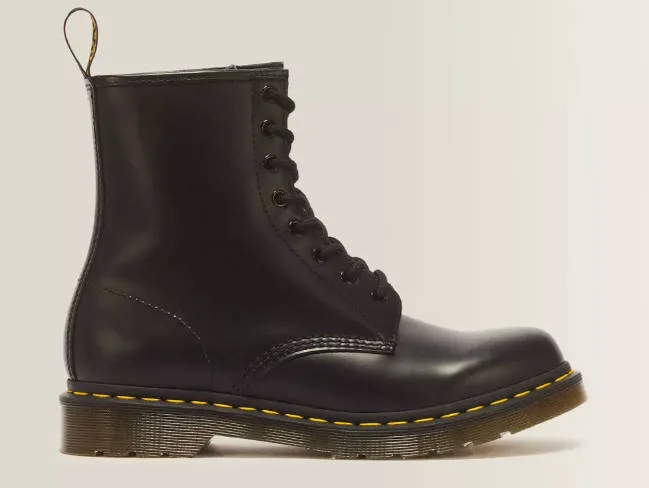
The Icon of Subculture
From 1970s punk rock stages to 2026 high-fashion runways, the Dr. Martens 1460 8-eye boot and the 1461 3-eye shoe remain undisputed wardrobe essentials. Their rebellious DNA is woven into their very construction: the indestructible "Smooth" leather, the heavy welt stitch, and the iconic AirWair bouncing sole.
However, this global ubiquity comes with a heavy price. Dr. Martens are among the most counterfeited boots in the world. In 2026, counterfeit factories have moved far beyond the obvious, flimsy plastic knock-offs of the past. Top-tier replicas now utilize real leather and attempt to mimic the complex air-cushioned soles.
To authenticate a pair of "Docs" today, you cannot simply look at the overall shape. You must act like a forensic cobbler. Authenticity lies in the tension of the welt stitch, the precise opacity of the sole, and understanding the heavily misunderstood differences between standard Asian-made models and the premium "Made in England" (MIE) line.
This guide will break down the ultimate signs to spot a counterfeit pair of Dr. Martens and protect your investment.
The 30-Second Authenticity Checklist
Shopping online on platforms like Depop or Vinted, or checking a pair at a vintage thrift store? Run through this rapid filter. If the boot fails any of these checks, you are almost certainly holding a replica:
-
🚩 The Welt Stitch Test: Is the iconic stitching (whether classic yellow, red, or white) a bright, harsh neon color? Does it look glued on? (Authentic stitching is warm-toned, evenly spaced, and physically sews the upper to the sole).
-
🚩 The Sole Opacity: Is the sole completely dark and solid brown, or totally transparent like clear jelly? (Authentic AirWair soles are two-tone and semi-translucent, allowing you to clearly see the internal honeycomb structure under light).
-
🚩 The Leather Edge Test: Look at a raw, unhemmed cut edge of the leather (like near the shoelace holes). Do you see a white, synthetic mesh sandwiched in the middle? (Authentic leather is a solid hide, showing raw, suede-like edges when cut).
-
🚩 The Heel Loop Typography: Does the "AirWair" heel pull tab feature blurry, misaligned text, or is it missing the specific swooping tails on the 'A' and 'W'?
-
🚩 The "AirWair" Insole Print: Is the printed logo inside the shoe peeling or rubbing off completely after a single wear, or is there a cheap, removable full-length foam insole? (Standard Docs use a glued half-insole).
Need the full breakdown? Let's dive deep into the 5 ultimate signs.
Deep Dive: The 5 Ultimate Signs of Authenticity
Sign 1: The Welt Stitching & The Joint Overlap (The Soul of the Doc)
The heavy stitching around the sole isn't just decorative; it's the physical thread that secures the leather upper to the Goodyear welt. Counterfeit factories often try to fake this complex, heavy-duty sewing technique to save money.
|
Feature |
✅ Authentic Dr. Martens |
❌ Counterfeit (Fake) |
|---|---|---|
|
Thread Color & Material |
Uses a thick, wax-coated nylon thread. While the classic color is a warm golden/mustard yellow, Dr. Martens regularly releases models with red, black, white, or green stitching. Regardless of color, the authentic thread is deep, rich, and never neon or cheap-looking (e.g., authentic red is a deep, solid crimson, never neon pink/red). |
Frequently uses a fluffy cotton thread, or a harsh, overly bright neon yellow or bright plastic red thread that looks cheap. Fake colored threads often bleed dye onto the rubber welt. |
|
Stitch Tension & Size |
The stitches are distinctly large, robust, and evenly spaced. Crucially, they sit deeply and securely within the grooved channel of the rubber welt. |
Stitches are too small, unevenly spaced, or wander lazily out of the welt groove, sitting high on the surface. |
|
The "Fake Stitch" Flaw |
The thread is a continuous, structural loop that genuinely binds the boot. |
The Glued-String Flaw: Cheap fakes completely skip the Goodyear welting process. They glue the leather directly to the sole and then glue a strip of colored string around the outside. |
|
The Welt Overlap Joint (Crucial) |
Look at the inner side of the shoe near the instep. You will see an angled, overlapping joint where the two ends of the thick rubber welt meet and are melted together. This "scar" is a hallmark of genuine welted construction. |
The welt is a single, seamless molded piece of plastic (like a hula hoop), or the overlap joint is a straight, sloppy, unsealed cut. |
🔍 The Sensory Pro-Tip: Run your fingernail under the heavy stitching. On an authentic pair, the heavy wax-coated nylon feels tight, secure, and structural. On a bad fake, you can literally pry the string away from the rubber with your nail because it is just glued to the surface.
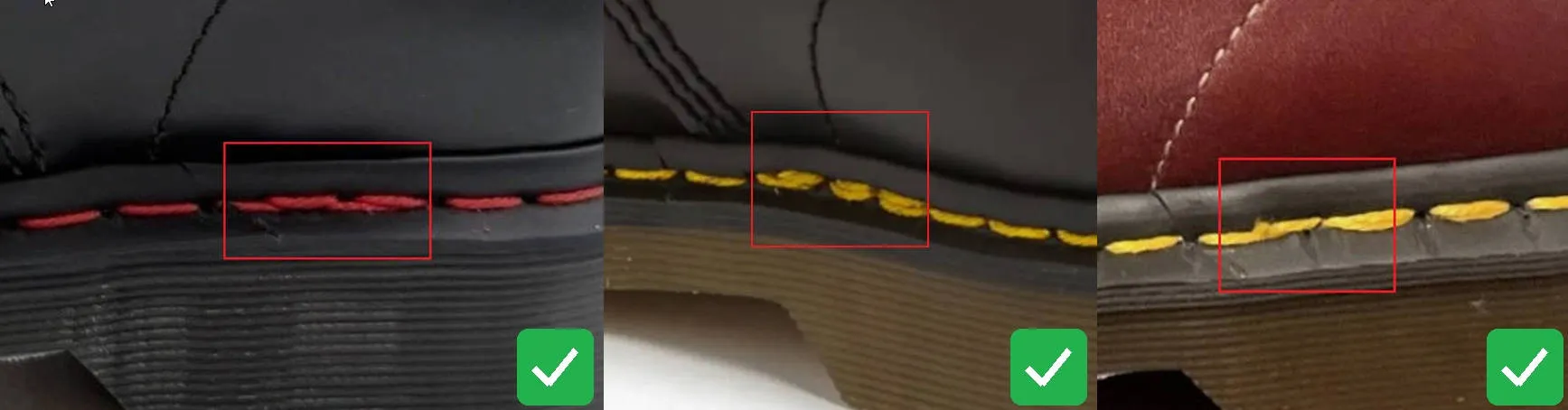
📸 Authentic Reference Standard: Lock your eyes on the heavy welt stitch (whether it's the classic mustard yellow or a special edition red). Notice how the thick, wax-coated thread sits deep within the grooved channel of the welt. Crucially, look at the angled overlapping joint on the inner side of the rubber welt—this distinct "scar" is the ultimate proof of authentic Goodyear welted construction, not a defect.
Sign 2: The AirWair "Bouncing Sole" (Transparency & Grid)
The AirWair sole was a revolution in comfort. It contains pockets of air housed within a structured grid. Counterfeiters routinely fail at replicating this chemical rubber mix and complex internal molding.
|
Feature |
✅ Authentic Dr. Martens |
❌ Counterfeit (Fake) |
|---|---|---|
|
Opacity & Internal Grid |
Features a distinct two-tone, semi-translucent gum/brown color. If you hold it up to a bright light, you can clearly see the internal honeycomb/diamond grid structure inside the sole. |
Usually falls into two extremes: Either completely opaque/solid (painted dark brown plastic) where no light passes through, or extremely clear and flimsy like cheap jelly with no internal structure visible. |
|
Sole Edge Texture |
The vertical side walls of the sole feature distinct, parallel grooved lines running around the shoe (similar to the grooves on a thick vinyl record). |
The sides of the sole are completely smooth, or the grooves look artificially deep and shiny. |
|
Bottom Imprint Typography |
Look at the bottom of the sole. The text "OIL FAT ACID PETROL ALKALI RESISTANT" and the Dr. Martens cross logo are sharply molded and deeply debossed. The edges of the letters are crisp. |
The text is shallow, blurry, misspelled (e.g., missing the 'L' in ALKALI), or looks like it is "melting" into the surrounding rubber due to cheap, degraded molds. |
🔍 The Sensory Pro-Tip: The Flashlight Test. Take your smartphone flashlight and press it directly against the side of the sole in a dark room. On an authentic pair, the light will illuminate the internal geometric air pockets. On a fake solid-rubber sole, the light will not penetrate at all, or it will just show a hollow, empty shell.
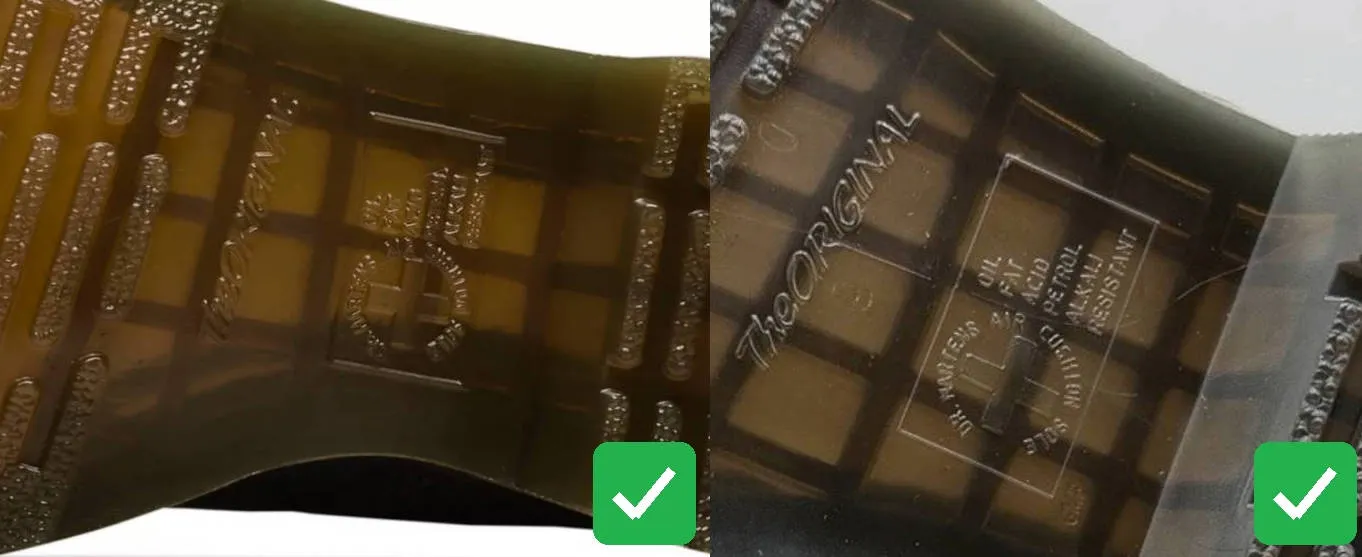
📸 Authentic Reference Standard: The semi-translucent AirWair sole. Notice how you can faintly see the internal diamond/honeycomb grid structure through the two-tone rubber. Focus on the bottom molding: the "OIL FAT ACID PETROL ALKALI RESISTANT" text must be incredibly sharp with no melting edges.
Sign 3: The Leather Quality & The "Raw Edge" Sandwich Test
Dr. Martens uses several types of leather, but the classic "Smooth" leather is the most iconic—and the most faked. Fake factories use "PU Leather" (Polyurethane plastic) to cut costs. The easiest way to spot PU leather is to look at a raw, unhemmed cut.
|
Feature |
✅ Authentic Dr. Martens (Solid Hide) |
❌ Counterfeit (Fake) |
|---|---|---|
|
The "Raw Edge" Cut Test (Crucial) |
Authentic pairs use solid hide. To verify this, you must look at a "raw," unhemmed edge of the leather. Where to look based on your model: • Pascal Models (Unhemmed Collar): Look directly at the top opening of the boot. • Classic Smooth Models (Bound Collar): The top collar has a black binding. Instead, look at the unhemmed edges around the lace eyelet panels. The Result: The exposed cut should look like genuine dyed hide, showing a slightly grayish, raw, suede-like core. |
The White Sandwich Flaw: PU leather is often backed by synthetic fabric. Look at the cut edge—if you see a white, mesh-like fabric sandwiched between the outer color and the inner lining, it is 100% fake PU plastic. |
|
The Leather Finish & Creasing |
Authentic 'Smooth' leather has a highly durable semi-matte finish. When worn, it develops fine, organic micro-creases. |
Excessively shiny (looking like plastic wrap). When bent, fake PU leather forms harsh, sharp, angular folds that quickly begin to crack and peel off in flakes. |
|
The Toe Box Silhouette |
The 1460 and 1461 feature a structured, slightly bulbous, but proud toe box. It has a distinct upward slope. |
The "Clown Shoe" Flaw: Fakes frequently use incorrect, generic lasts. The toe box is either entirely flat/deflated or comically round, bulky, and oversized like a clown shoe. |
🔍 The Sensory Pro-Tip: The "Break-In" test. Authentic Smooth leather requires a notoriously painful break-in period because the thick, solid hide needs to heat up and mold to your foot. If your brand new "Smooth" leather Docs feel as soft, flimsy, and flexible as a pair of socks on day one, you likely have a PU plastic fake.
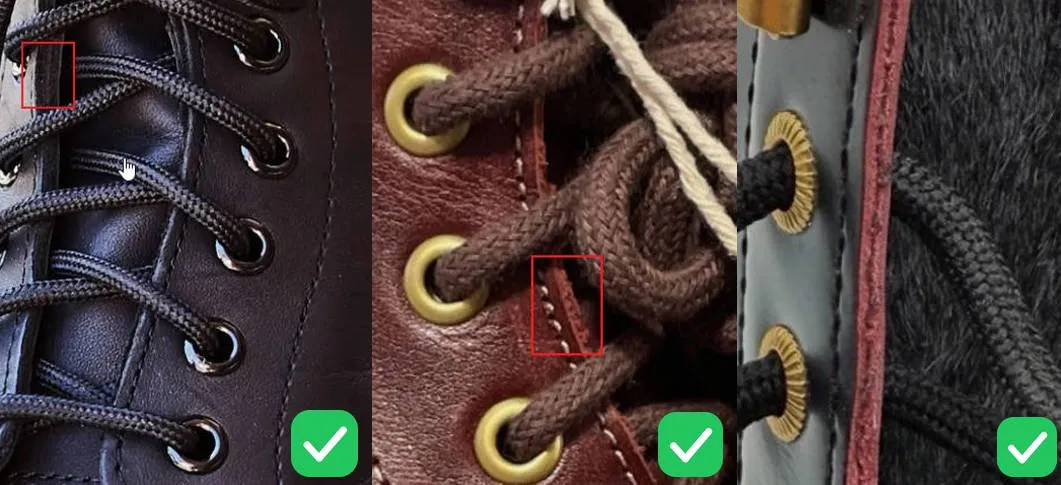
📸 Authentic Reference Standard: Because the classic 1460 Smooth has a collar binding, look at the unhemmed edges around the lace eyelet panels. This raw cut reveals the solid, genuine hide. Replicas using cheap PU leather will expose a hidden, synthetic white mesh sandwich layer here. Also, note the semi-matte finish of the genuine Smooth leather.
Sign 4: The Heel Loop (The "AirWair" Tab)
The embroidered pull tab on the heel is a primary branding element. Because it requires a high-density embroidery machine and a specific fabric weave, it is a massive stumbling block for counterfeiters.
|
Feature |
✅ Authentic Dr. Martens |
❌ Counterfeit (Fake) |
|---|---|---|
|
Fabric Weave |
The loop itself is made of a heavy, durable canvas material with a distinctly visible twill weave. |
The loop feels thin, silky, or like cheap nylon backpack strapping. |
|
Typography & Font Details |
The front reads "AirWair". Look closely at the swooping, elongated tails on the 'A' and 'W'—they are a very specific shape. The back reads "With Bouncing Soles". |
Often misspelled, or the font is overly bold/generic. The distinct, elegant swoops on the 'A' and 'W' are frequently missing or rendered as standard block letters. |
|
Embroidery Color & Quality |
The text is embroidered in a dense thread that matches the welt stitching color (e.g., golden yellow, red, or white). |
The embroidery is messy, uses overly bright thread, or features rogue connecting threads jumping between the letters. |
|
Attachment Seam |
The loop is securely anchored deeply into the heel seam of the leather before the backstrip is sewn over it. |
The loop looks superficially tacked onto the outside surface of the leather and can be easily ripped off with a hard pull. |
🔍 The Sensory Pro-Tip: Run your thumb over the embroidered text on the heel loop. It should feel significantly raised, dense, and tactile. Cheap fakes often use a flat, printed-on material or incredibly sparse, thin thread that lacks any 3D depth.
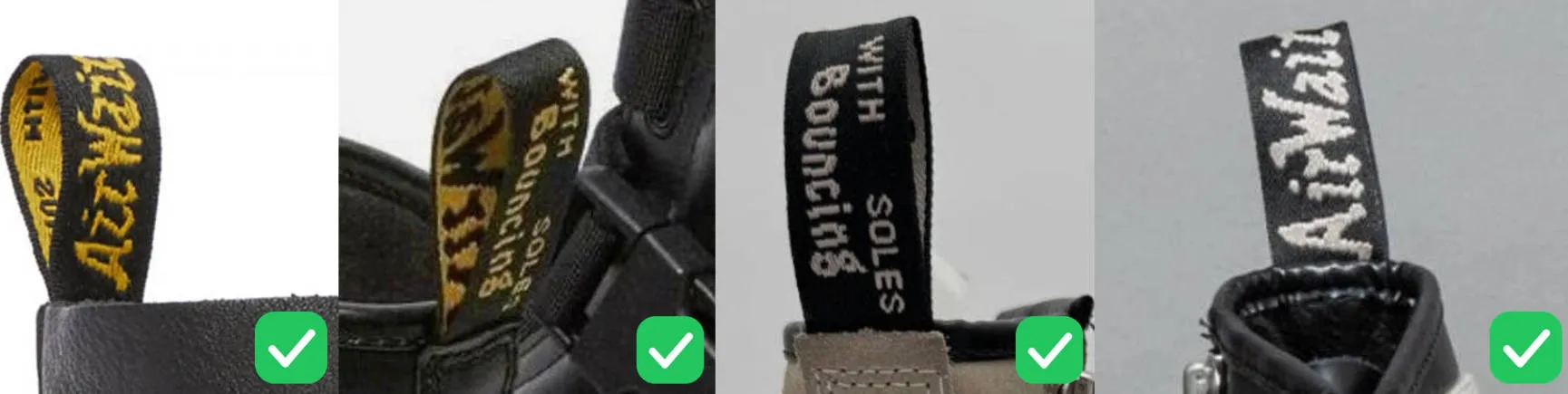
📸 Authentic Reference Standard: The AirWair heel loop. Pay extreme attention to the typography—specifically the swooping, elongated tails on the 'A' and 'W'. The embroidery must be crisp, dense, and deeply anchored into the heel seam.
Sign 5: Inner Tags, Insoles, and the Sizing Label
The internal construction and tagging are crucial. Note: Dr. Martens has updated its tagging system in recent years, which you must be aware of to authenticate modern releases.
|
Feature |
✅ Authentic Dr. Martens |
❌ Counterfeit (Fake) |
|---|---|---|
|
The Insole Construction |
Standard Docs feature a glued-down half-insole covering the heel and arch area. The front half of the footbed is exposed, showing a thick felt-like material or fibrous board. The Dr. Martens printed logo is crisp and durable. |
Fakes frequently insert a cheap, full-length, completely removable EVA foam insole. The printed logo is blurry and rubs off onto your socks after a few hours of wear. |
|
Modern Sizing Label |
Many newer Asian-made standard models now feature a white woven tag (often stitched behind the tongue or on the inner side). It contains a specific product code (e.g., 11822002 for a black 1460) and a grid showing UK, US M, US L, and EU sizes. |
Fakes using the modern white tag often have blurry text with bleeding ink. Crucially, they frequently use the wrong product code (e.g., stamping the code for a black boot onto a red boot) or feature mathematically incorrect size conversions. |
|
Vintage/Classic Stamped Details |
On older models or current "Made in England" pairs, the sizing and origin are stamped directly onto the leather inside the tongue in a distinct, metallic (gold/silver) or white font. |
The stamped printing is heavily smudged, unreadable, or completely lacks the specific model number. |
🔍 The Sensory Pro-Tip: Check the sizing conversion and product code on the tag or stamp. Authentic Dr. Martens use standard conversions. A common fake flaw is printing a mathematically incorrect EU size for a given US/UK size. Always Google the product code printed on the inner tag—if the search results show a completely different style or color, it is a fake.
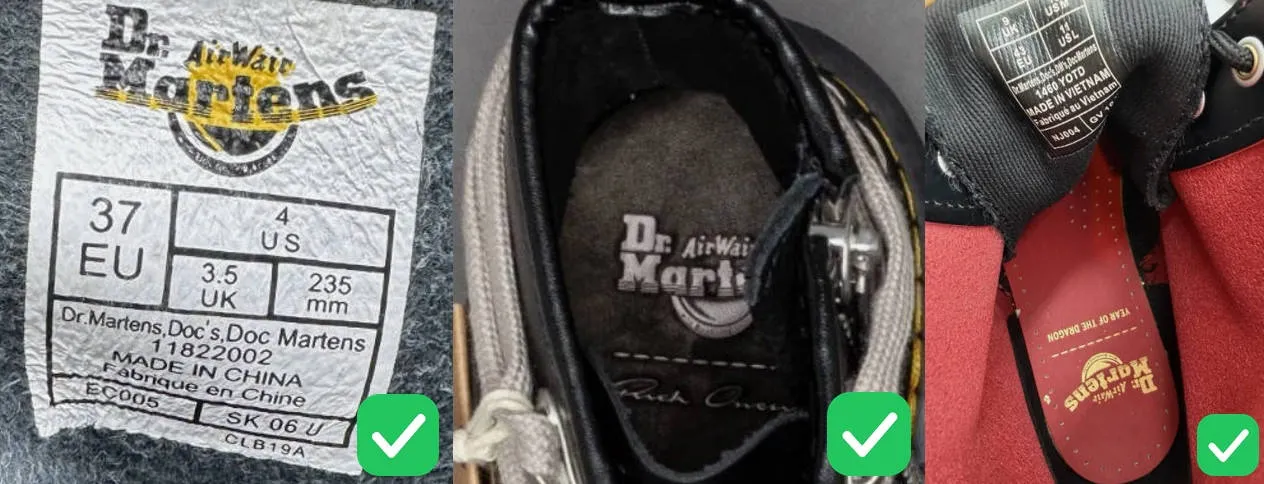
📸 Authentic Reference Standard: The internal layout. Notice the securely glued half-insole with a sharply printed logo. If your boot has the modern white sizing tag, ensure the text is crisp, without ink bleeding. Crucially, verify that the printed product code matches the exact style and color of your boot, and that the UK/US/EU size conversions are mathematically accurate according to the official brand chart.
The Dr. Martens Matrix: MIE, Model Variations & Collabs
To properly authenticate a pair of Dr. Martens, you must first know exactly what model and tier you are looking at. Counterfeiters frequently mix up features across different lines, providing massive red flags for educated buyers.
1. The Heritage Matrix: Asian-Made vs. "Made in England" (MIE)
The Biggest Myth in Dr. Martens Authentication: "My boots say Made in Vietnam. They must be fake because real Docs are Made in England."
This is 100% False. In the early 2000s, Dr. Martens moved the vast majority of its mass production to Asia (Vietnam, Thailand, China, Lao, Bangladesh). Standard authentic Docs will say made in these countries. However, they still produce a premium line called "Made in England" (MIE) in their original Cobbs Lane factory in Wollaston, UK. Use this matrix to spot fakes trying to pass as premium MIE pairs.
|
Feature |
Standard Dr. Martens (Asian Made) |
"Made in England" (MIE) Premium Line |
🚨 Fake "MIE" Red Flags |
|---|---|---|---|
|
Retail Price |
~$170 USD |
~$250 - $300+ USD |
Fakes are often sold suspiciously cheap (~$80) on resale apps, claiming to be "Vintage English." |
|
Leather Quality |
Uses standard "Smooth", Nappa, or Virginia leathers. |
Frequently uses premium Quilon leather (thicker, richer texture, with a distinct vintage, unlined finish showing the brown hide core). |
Fake "MIE" pairs often stamp "Made in England" on cheap, overly shiny, plastic PU leather. |
|
Insole Branding |
Standard print, usually silver, white, or black text. |
The Gold Standard: Features brilliant gold foil text stamped on the insole reading "MADE IN ENGLAND". |
Fakes use dull yellow paint instead of genuine metallic gold foil. |
|
Origin Markings |
Sizing printed on the inside of the tongue or on a woven white tag. |
Origin is proudly stamped on the sole and directly into the leather on the insole. |
Fakes will sometimes print "Made in China" on the tongue tag, but stamp "Made in England" on the sole (a massive, immediate contradiction). |
|
Accessories |
Standard black/brown shoebox. |
Comes in a premium MIE box, includes a dust bag, and features a thick cardboard heritage booklet/tag attached to the laces with natural string. |
Missing the heritage tag entirely, or the tag uses a cheap plastic zip-tie instead of natural string. |
2. The Core Model Matrix: Smooth vs. Pascal vs. Platforms (Bex/Jadon)
Counterfeit factories often use one generic mold to produce all their boots. Knowing the specific structural differences between the core models will help you catch them cutting corners.
|
Model Type |
Defining Authentic Features |
🚨 Specific Fake Flaws |
|---|---|---|
|
1460 Smooth (The Classic) |
Constructed from highly stiff, polished "Smooth" leather. Crucial detail: Features a black folded collar binding (hem) around the top opening. |
The Soft Fake: Fake Smooth leather often feels incredibly soft and flimsy out of the box (like PU plastic). Fake factories sometimes forget to sew the black collar binding onto the top edge. |
|
1460 Pascal (The Softer Sibling) |
Constructed from softer leathers (Virginia, Nappa, Ambassador). Crucial detail: Features a raw edge / unhemmed collar (no binding around the top opening). |
The Stiff Pascal: Fakes mistakenly use rigid, shiny plastic leather for Pascals. They also frequently sew a black binding onto the top, failing to realize the "Pascal" moniker specifically means a raw, unhemmed edge. |
|
Bex / Quad / Jadon (The Platforms) |
Bex: Slightly thicker, rugged sole.
Quad/Jadon: Massive platform sole. The Jadon features an inner side zipper. |
The Sole Density & Zipper Flaw: Fake platforms are either extremely heavy (solid cheap PVC brick) or entirely hollow (lightweight EVA foam). On fake Jadons, the inner zipper is unbranded, gets stuck easily, and lacks the specific heavy-duty YKK pull tab found on authentic pairs. |
3. The High-End Collaboration Matrix
When Dr. Martens collaborates with high-fashion houses, they introduce unique tooling, hardware, and packaging. These details are notoriously difficult for counterfeiters to replicate profitably.
-
Rick Owens (The Jumbo Lace & Pentagram): The most heavily counterfeited collaboration. Authentic RO pairs use premium, extremely supple leathers (like 'Lunar' or 'Tauryon').
-
🚨 Fake Flaws: The geometry of the pentagram lacing is usually incorrect (asymmetrical or too tight). The wrap-around Jumbo laces on fakes are often too thin and feel like cheap cotton. Finally, check the side zipper: Authentic pairs use heavy-duty YKK zippers with a distinct, elongated pull tab; fakes use generic, short zipper pulls that derail easily. The tongue on fakes is also usually too short and lacks the exaggerated padding of the authentic RO design.
-
-
Supreme: Supreme collaborations frequently feature unique leather treatments, such as vintage graphic prints or intricate web embossing, and always feature Supreme branding (like the box logo or embroidered heels).
-
🚨 Fake Flaws: The embroidery density on the heel is poor, showing loose connecting threads. The Supreme Box Logo printed on the insole often uses the wrong font weight (too thin or lacking the specific italic slant).
-
-
Comme des Garçons (CDG) & Undercover: CDG pairs often play with minimalism (sometimes omitting the yellow welt stitch entirely for a mono look) or using unique paneling. Undercover pairs often feature specific embossing (like "Chaos / Balance" or grid patterns).
-
🚨 Fake Flaws: Fake factories struggle with the precise pressure required for the "Chaos/Balance" embossing, making it either far too shallow (barely readable) or stamped so hard it warps the surrounding leather.
-
Where to Buy Authentic Dr. Martens
Because the "Smooth" leather finish and distinctive stitching are easily mimicked in low-res photos, we strongly advise against buying Docs on peer-to-peer apps like Poshmark, Facebook Marketplace, or Vinted without rigorous physical checks.
Primary Options (100% Guaranteed Authentic):
-
Official Dr. Martens Boutiques & Website: The absolute safest method to secure both standard and Made in England (MIE) pairs.
-
Authorized Retailers: Major footwear chains like Journeys, Zappos, ASOS, and Nordstrom Rack are direct, verified partners of the brand.
-
Luxury Stockists (For MIE & Collabs): Platforms like SSENSE and END. Clothing frequently carry the premium Made in England line and high-profile fashion collaborations (like Rick Owens or Supreme).
Reputable Secondary / Resale Markets: If you are hunting for a sold-out collaboration or a discontinued vintage MIE pair, use platforms that provide physical, expert authentication:
-
eBay (Authenticity Guarantee): Highly recommended. Look for the blue checkmark indicating the boots will be verified in-hand by independent experts before delivery.
-
StockX & GOAT: Both platforms physically authenticate footwear. They are excellent sources for tracking down rare, deadstock collaborations.