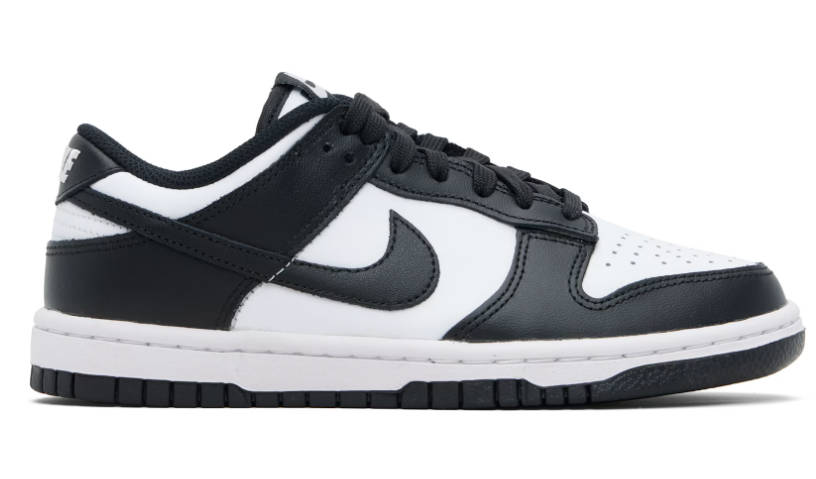
The Sneaker That Broke the Rules
From its initial release in 2021 through 2026, the Nike Dunk Low "Black/White" (universally known as the "Panda Dunk") has maintained an unprecedented grip on sneaker culture. It became the undisputed "global uniform" of the 2020s, prompting Nike to restock it more times than almost any other shoe in history.
However, this mass production created the ultimate headache for authenticators: The QC Paradox.
Because Nike had to produce millions of these shoes at breakneck speed, the official retail Quality Control (QC) is notoriously terrible. It is incredibly common for authentic retail Panda Dunks to arrive directly from Nike with messy stitching, asymmetrical toe boxes, and wild glue stains.
Meanwhile, high-end counterfeit factories (producing top-tier batches like the "M Batch" and "VT Batch") have spent years perfecting this simple black-and-white leather silhouette. In 2026, a top-tier fake Panda Dunk often has better, cleaner stitching than a genuine Nike pair!
Therefore, traditional legit-checking methods ("messy stitching means it's fake") do not work on Panda Dunks.
To authenticate this shoe in 2026, you must ignore minor cosmetic flaws and focus strictly on objective manufacturing data: leather density, specific typographical font weights on the size tags, and the tongue label.
The 30-Second Authenticity Checklist
Shopping on platforms like Depop, Vinted, or eBay? Run through this rapid filter. If you spot any of these red flags, you are likely dealing with a replica:
-
🚩 The Toe Box "Pop" Test: Press down firmly on the center of the white toe box leather. Authentic coated leather will instantly "pop" back up to its original shape. Fakes often use cheap, thin PU synthetic leather that stays dented, creases heavily, or feels like stiff cardboard.
-
🚩 The Heel "NIKE" Embroidery: Look at the white "NIKE" text on the back heel tab. Counterfeiters frequently make the letters too thin, spaced too far apart, or connect the letters with stray, messy white threads. (Retail embroidery should be thick, bold, and fill up most of the black tab).
-
🚩 The Midsole Paint Job: Inspect the boundary where the black rubber outsole meets the white midsole. While retail pairs have minor paint flaws, fakes often have terrible, wavy black paint bleeding aggressively up into the white rubber.
-
🚩 The Size Tag Font Weight: Check the sizing tag inside the shoe. Are the "UPC" or "CM" text lines excessively bold, smudged, or bleeding together? (Fake factories consistently fail to match the thin, crisp font weight of the authentic tag).
-
🚩 The Tongue Label '®': Look at the white label on the outer tongue. Is the tiny registered trademark '®' inside a very thick circle, or is the letter 'R' touching the edges of the circle? (Authentic '®' symbols are delicate with a thin outer circle).
Need the full breakdown? Let's dive deep into the 5 ultimate signs.
Deep Dive: The 5 Ultimate Signs of Authenticity
Sign 1: Leather Quality & Toe Box Shape (The Material Flaw)
While top-tier 2026 fakes (like M Batch) have excellent shape, budget and mid-tier batches always compromise on the density and cost of the materials. Because you cannot always see this in photos, you must test the tactile feedback.
|
Feature |
✅ Authentic Nike (Retail) |
❌ Counterfeit (Fake) |
|---|---|---|
|
White Leather Texture |
Panda Dunks use a heavily coated synthetic leather. It feels relatively smooth but possesses a distinct density and rigidity. It provides firm resistance when pressed and instantly bounces back without leaving a dead crease. |
Typically falls into two extremes: It either feels excessively soft and flimsy (like cheap plastic wrap) offering no support, or it is incredibly stiff and papery, creasing violently with sharp, jagged lines when bent. |
|
Toe Box Profile |
From a side profile, the authentic toe box has a smooth, aerodynamic downward slope that hugs the front of the foot closely. The perforations (breathing holes) are cleanly punched through with no frayed edges. |
The "Cliff" Flaw: Fakes frequently use generic, oversized molds. This results in a bulky, inflated toe box that looks like a vertical cliff from the side (often called the "clown shoe" look). The perforations often have tiny white leather flakes stuck inside them. |
|
Outsole Star Pattern |
Examine the tiny stars on the front tip of the outsole. Authentic stars are pressed by high-precision molds—they are sharp, distinct, and highly 3-dimensional. |
Due to degraded or cheap molds, fake stars often look shallow, dull, or smudge together into a flat, undefined mess. |
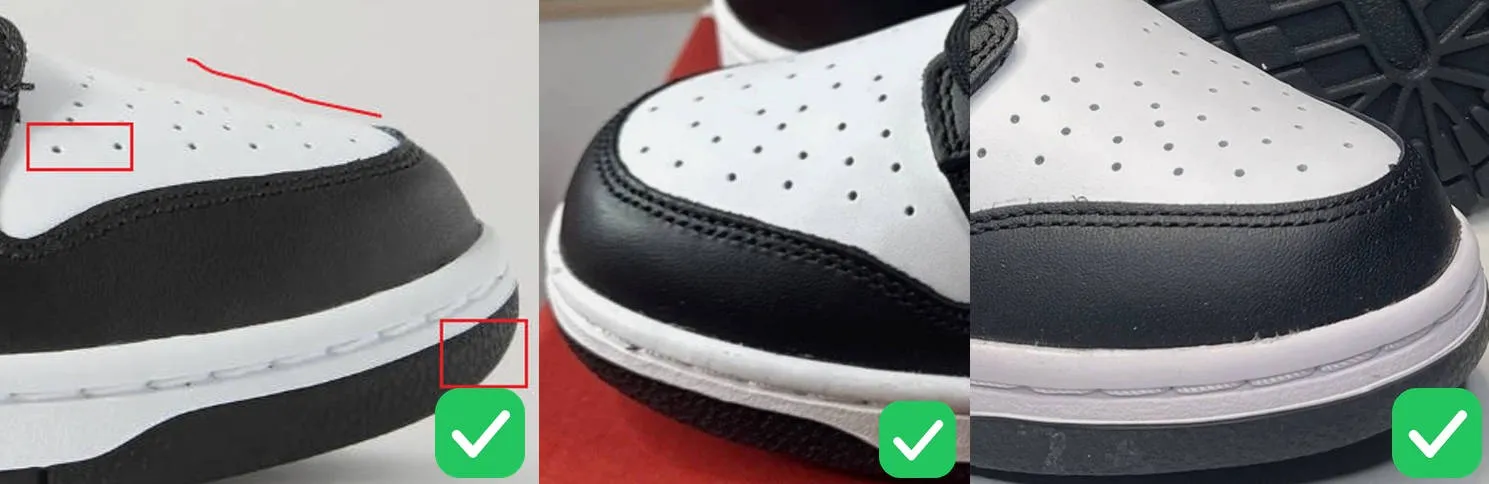
Caption: 📸 Authentic Reference Standard: Focus on the aerodynamic side profile of the toe box. It should look sleek and slightly deflated, not tall and bulky like a cliff. Notice the smooth, slightly rigid texture of the white coated leather. When pressed, it should provide firm resistance and instantly pop back to this shape.
Sign 2: Heel Embroidery & Swoosh Proportions
The rear heel tab is the "Achilles' heel" of replica factories. Even the best batches struggle to get the precise thickness of the Nike embroidery correctly calibrated.
|
Feature |
✅ Authentic Nike (Retail) |
❌ Counterfeit (Fake) |
|---|---|---|
|
"NIKE" Heel Embroidery |
Uses thick, dense white thread. The letters are bold, heavily packed, and take up the majority of the black heel tab space. The spacing between the letters is minimal but distinct. |
The letters are noticeably thin and "starved." There is too much empty space between the letters, and you will frequently see stray white connecting threads (jump stitches) running directly between the letters like spiderwebs. |
|
Horizontal Alignment |
The "NIKE" text sits on a relatively straight horizontal plane, parallel to the bottom of the heel tab. |
The text is often crooked. The 'E' might sit significantly higher than the 'N', or the entire word slants noticeably to the left or right. |
|
The Swoosh Tail |
As the black Swoosh wraps around the shoe toward the heel, it tapers smoothly and naturally into a sharp, elegant point just before touching the heel tab. |
The Swoosh is often cut too thick, and the tail end terminates abruptly, looking bulky or rounded rather than tapering cleanly into a sharp point. |
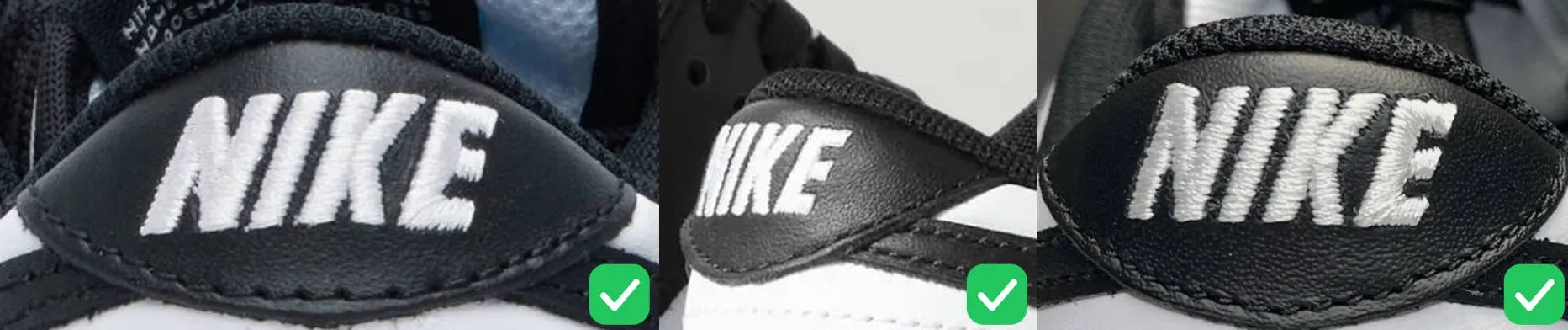
Caption: 📸 Authentic Reference Standard: Lock your eyes on the white "NIKE" embroidery on the heel. The authentic thread is dense and the letters are exceptionally thick and bold, taking up most of the black leather tab. Note the absolute absence of stray white "jump threads" connecting the letters together—a common flaw on replicas.
Sign 3: Midsole Stitching & The Paint Line
Disclaimer: Authentic retail Panda Dunks have notoriously sloppy stitching! However, we are looking for the type of sloppiness that indicates a fake.
|
Feature |
✅ Authentic Nike (Retail) |
❌ Counterfeit (Fake) |
|---|---|---|
|
Stitching Tension |
The white thread wrapping around the midsole is pulled tight. Even if the stitches are slightly uneven, the thread itself sits securely and deeply within the grooved channel of the rubber. The stitch length is usually a consistent 2-3mm. |
The stitching feels loose, sits high on the surface of the rubber (you can easily catch it with a fingernail), or uses a strangely thin thread. Furthermore, fake thread sometimes has an off-white/yellowish tint rather than pure white. |
|
The Paint Line (Midsole/Outsole) |
The boundary between the black rubber outsole and the white foam midsole is relatively distinct and follows the sculpted line of the shoe. |
The "Wavy Paint" Flaw: Fake factories rush the painting/gluing process. You will often see the black paint bleeding heavily and unevenly (like aggressive, jagged waves) up into the white midsole. |
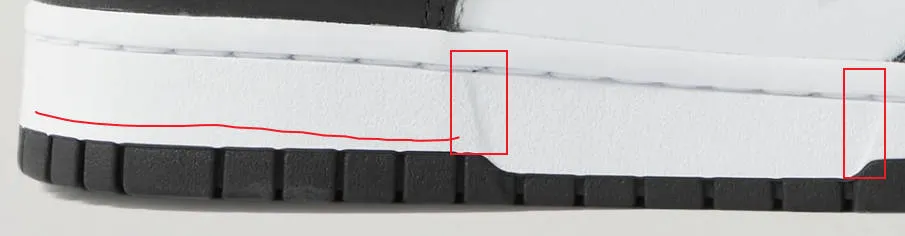
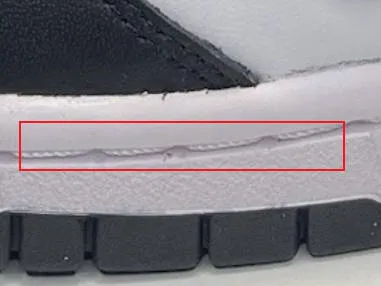
Caption: 📸 Authentic Reference Standard: Observe the boundary where the black rubber meets the white midsole. While retail pairs aren't always flawless, the line should be relatively crisp. Focus heavily on the white midsole stitching: the thread must be pure white, tightly tensioned, and seated firmly within the rubber groove, not floating loosely on top.
Sign 4: The Inner Size Tag (The Typographical Lie Detector)
Because counterfeiters print these tags in massive, identical batches, the size tag remains one of the most objective ways to authenticate a Dunk in 2026 without relying solely on the shoe's external shape.
|
Feature |
✅ Authentic Nike (Retail) |
❌ Counterfeit (Fake) |
|---|---|---|
|
Font Weight (Crucial) |
Look specifically at the "UPC", "CM", and the "MADE IN..." text. Authentic Nike tags use a very specific, crisp, and relatively thin font weight. You can clearly see the negative space (the blank white areas) inside small letters like 'e' and 'a'. |
The Ink Bleed Flaw: Fake tags almost always print these letters too heavily. The text looks bold and smudged. The negative space inside the letters 'e' or 'a' is completely filled in with black ink because the font is too thick (especially noticeable on the 'CM' and the style code 'DD1391-100'). |
|
Text Proportions |
The registered trademark "®" symbol above the word "SWOOSH" is small, delicate, and proportional. |
The "®" symbol on fakes is frequently oversized, excessively bold, and placed uncomfortably close to the letter 'H' in "SWOOSH". |
|
Date Alignment |
Production dates (e.g., 03/10/25 | 05/20/25) are aligned evenly on the same horizontal plane. |
The dates are often misaligned vertically, or the slashes ( |
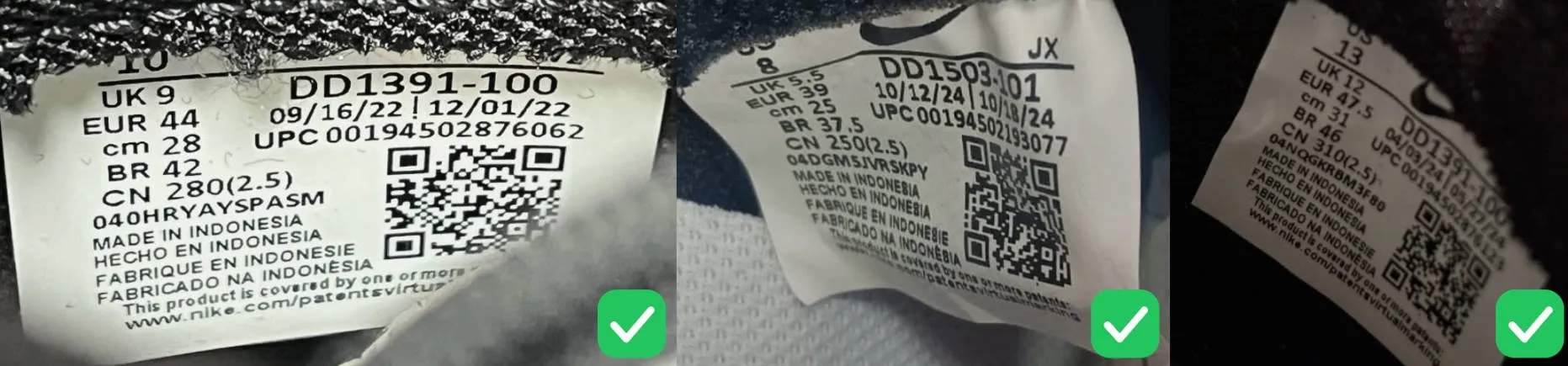
Caption: 📸 Authentic Reference Standard: This is your typographical lie detector. Look extremely closely at the font weight of the "UPC" code and the "CM" text. Authentic ink is applied precisely, resulting in thin, highly legible text with clear negative space inside the letters. Counterfeits frequently suffer from ink bleed, making these letters look bold, blurry, and smudged together.
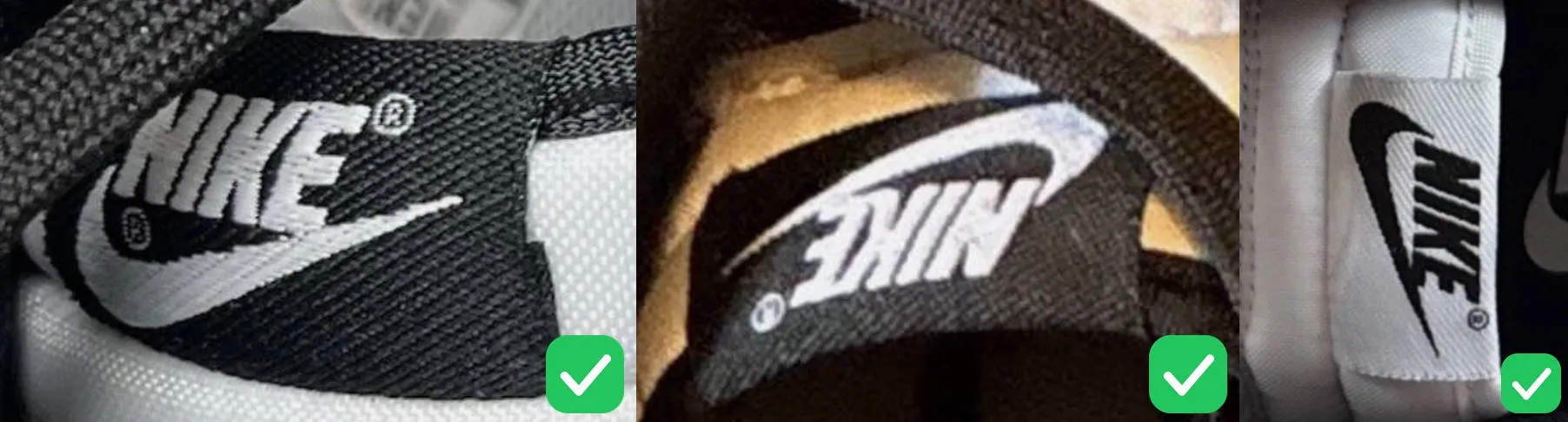
Sign 5: The Tongue Label Typography (The Embroidery Flaw)
Even the most advanced replica factories often struggle with the micro-embroidery required for the white woven tag on the front of the tongue. This provides a highly reliable, easy-to-photograph authentication point.
|
Feature |
✅ Authentic Nike (Retail) |
❌ Counterfeit (Fake) |
|---|---|---|
|
"NIKE" Letter Spacing |
The letters in "NIKE" are tightly and consistently kerned (spaced). Specifically, look at the gap between the 'I' and the 'K'—it should be minimal. |
The Spacing Flaw: Fake factories frequently misalign the embroidery machine, causing the letters to be spaced too far apart. The gap between the 'I' and 'K', or 'K' and 'E', is often noticeably wide. |
|
The '®' Symbol (Crucial) |
Look at the tiny registered trademark '®' above the Swoosh. The authentic circular border is thin and delicate. The letter 'R' inside sits comfortably in the center and does not touch the outer circle. |
The Bold '®' Flaw: On fakes, the circular border is embroidered too thickly. Consequently, the letter 'R' looks oversized, bloated, and almost always bleeds into or touches the edges of the thick outer circle. |
|
Swoosh Placement |
The tip of the red Swoosh extends just slightly past the bottom of the letter 'N'. |
The Swoosh tip is either cut off too early (stopping under the 'N') or extends way too far to the left. |
Caption: 📸 Authentic Reference Standard: Focus heavily on the typography of the outer tongue label. On an authentic pair, the letters in 'NIKE' are tightly spaced (pay attention to the small gap between 'I' and 'K'). Crucially, look at the registered trademark '®' symbol. The authentic circle encasing the 'R' is thin, and the letter itself does not touch the edges of the circle. Replicas frequently use a bold circle with an oversized 'R' that touches the borders.
Advanced Verification: Cross-Referencing & Packaging
While the five visual signs above are your primary defense, professional authenticators use a battery of secondary data checks and packaging inspections to confirm a shoe's legitimacy. These checks are especially useful when dealing with top-tier 1:1 batches that have mastered the shoe's external shape.
1. The UV Light (Blacklight) Test
Shine a 365nm UV flashlight in a completely dark room over the shoe and box.
-
The Hidden Pen Marks: Counterfeit factories frequently use invisible UV pens to draw layout guidelines on the leather to help workers align the Swoosh and stitching. Under UV light, fake pairs will light up with glowing neon pen marks. Authentic retail pairs will remain clean.
-
Radioactive Stitching: Look at the white midsole stitching. Cheap fake threads often contain extreme amounts of fluorescent brighteners, causing them to glow with a blinding, radioactive white/blue light. Authentic threads have a much duller, natural reflection.
-
The Box Label Glow: Authentic Nike box labels use a specific matte paper that absorbs UV light. Fake box labels often use cheap, highly fluorescent paper that glows blindingly bright under a blacklight.
2. The Data Match (Cross-Referencing)
Counterfeiters often mix and match tags and boxes from different batches. You must ensure the data tells a consistent story.
-
The Factory Code Check (Crucial): Locate the two-or-three letter factory code on the inner size tag of the shoe (e.g.,
LN4,PA,LNM,VT). Now, look at the sticker label on the outside of the shoebox. The factory code printed on the box MUST match the code on the size tag exactly. If the shoe saysVTand the box saysPA, you are dealing with a fake pair or a swapped box. -
Date Logic: Check the production dates on the inner size tag. While Panda Dunks are constantly restocked, the production dates should logically precede your purchase date/release date by about 2 to 4 months. If you buy a "brand new" pair in 2026, but the production date says 2021, and there is zero aging on the box, it is a massive red flag for a replica of an older batch.
3. The Unboxing Presentation
How the shoe is presented inside the box is often an afterthought for replica factories.
-
Factory Lacing: Authentic Panda Dunks arrive from the factory laced in a very specific, slightly loose criss-cross pattern. Crucially, the laces are never tied into a knot. The lace ends are simply tucked into the shoe. Budget fakes frequently arrive tightly laced or tied in a dead knot.
-
Tissue Paper: Authentic Nike unbranded tissue paper is crisp and usually a very subtle off-white color. Fakes often use thin, highly translucent, crinkly paper that feels like a cheap plastic grocery bag.
4. The Hidden RFID & Box Construction
-
The Hidden RFID Antenna: Modern Nike boxes (including most 2026 Panda restocks) feature an RFID chip embedded beneath the box label. If you gently peel back the box label or shine a strong smartphone flashlight through it from the inside of the box, you should see the faint, dark outline of a square RFID antenna circuitry. Many fakes skip this invisible detail completely.
-
The YCM/Stamp Sticker: Look inside the empty shoebox. Authentic pairs will almost always have either a small, circular sticker that reads "YCM" (a mold prevention sticker) or a faded ink stamp (factory QC code) printed on the raw cardboard inside the lid or at the bottom. The absence of both is highly suspicious.
-
Perforations (US Releases): If the box label features a US Suggested Retail price tag attached to the right side, it should have tiny, physical micro-perforations allowing it to be torn off easily. Fakes often print the dotted line but forget the actual physical holes.
The Panda Ecosystem Matrix: Retro, High, Vintage & More
Before declaring a shoe fake based on material feel, you must identify which specific version of the Panda Dunk you are holding. Nike has released several variations, and applying standard "Retro" legit-check rules to them will result in false negatives.
Use this matrix to identify your variant and spot the specific flaws replica factories make for each one.
|
Model Variant |
Key Visual Identifiers |
Material & Construction Profile |
🚨 Specific Replica Red Flags |
|---|---|---|---|
|
Dunk Low "Retro" (The Standard Panda) |
Classic low-top. Black/White woven tongue tag. Standard white midsole. |
Features heavily coated, slightly rigid synthetic leather. Standard white mesh sockliner. |
The "U-Toe" Flaw: Fakes use generic molds, making the toe box look like a bulky, blunt 'U' rather than a sleek, sloping slope. |
|
Dunk High "Panda" (The High-Top) |
High-top silhouette. Crucial: The tongue tag features RED "NIKE" branding instead of black. |
The leather often feels slightly thinner and more plush around the ankle collar compared to the Low. |
The Neon Red Flaw: Fakes frequently mess up the tongue tag embroidery, using a bright neon pink/red instead of the standard Nike crimson. Fake ankle collars are often too wide and tubular. |
|
Dunk Low "Vintage" Panda (The Aged Look) |
Sail (cream/off-white) midsole. Cream laces. Exposed raw foam on the edges of the tongue. |
Uses slightly softer leather with a very subtle natural texture. Features a distinctly ribbed, vintage-style inner collar lining. |
The Mustard Flaw: Fake factories struggle with the vintage color-matching. Fake midsoles are often aggressively yellow (mustard hue) rather than a subtle cream. Fake foam tongues are usually too thick and stiff. |
|
Dunk Low "Next Nature" (The Sustainable Panda) |
Bright Neon Green (or yellow) insole featuring the Nike Sunburst (Pinwheel) logo. |
Made from at least 20% recycled materials. The synthetic leather is noticeably stiffer and more "plastic-like" than the standard Retro. |
The Peeling Insole Flaw: Fake green insoles are notorious for having the pinwheel logo peel off entirely after a single wear. The upper material on fakes creases violently like cheap cardboard. |
|
Dunk Low "By You" (The Nike ID Custom) |
Custom "Nike By You" outer tongue tag. Ships in a special slide-out drawer box, not the standard red/white box. |
Premium Materials: Vastly superior to retail Pandas. Often features genuine tumbled leather or premium smooth calfskin options. |
The Quality Paradox: Do NOT flag these as fake just because "the leather feels way too nice." Fakes rarely replicate the custom drawer box accurately, often shipping in standard retail boxes. |
FAQ & Addressing Misconceptions
"I just opened my brand new Panda Dunks and they smell strongly of toxic industrial glue. Are they fake?" No, this is normal. Because Panda Dunks are produced and sold at such a massive volume, many pairs are packaged and air-freighted immediately after assembly in Asian factories. The glue hasn't had time to cure and off-gas. A strong chemical smell out of the box is incredibly common for authentic retail pairs in 2026. Do not rely on the "smell test."
"My Swoosh stitching is messy and there are glue stains everywhere. It must be a replica, right?" Wrong. Messy retail QC is the hallmark of the Panda Dunk. As mentioned, Nike's quality control on this specific model is heavily flawed. Crooked stitches or glue spots do not automatically mean it is fake (in fact, some fakes are stitched too perfectly). You must authenticate based on the size tag font weight, the UV test, and the toe box shape.
Where to Buy Authentic Nike Panda Dunk
Due to the overwhelming number of 1:1 replicas on the market in 2026, we strongly advise against peer-to-peer trades or buying from unverified sellers on platforms like Facebook Marketplace, Vinted, or Instagram without rigorous in-hand checks.
To guarantee authenticity, stick to the following verified retail and authenticated resale routes:
Primary Options (100% Guaranteed Authentic):
-
Official Website:
-
Nike Official Store & SNKRS App: The safest route. Watch for frequent, scheduled restocks.
-
-
Authorized Retailers:
-
Foot Locker: A primary official partner for Nike Dunk releases.
-
JD Sports & Finish Line: Major chains that receive massive retail allocations.
-
Nordstrom: Frequently stocks standard Pandas in both Men's and Women's sizing.
-
Authenticated Resale Platforms (Highly Recommended if Retail is Sold Out):
-
eBay (Authenticity Guarantee): Look for listings with the blue "Authenticity Guarantee" checkmark. The shoes are shipped to an independent authentication center for a physical, multi-point inspection before arriving at your door.
-
GOAT: An industry-standard platform that utilizes AI and expert authenticators.
-
StockX: The largest sneaker commodity market with dedicated authentication centers globally.
-
Flight Club: A legendary consignment store offering guaranteed authentic pairs (often at a slight premium).
Disclaimer: This guide is for educational purposes only. All trademarks belong to their respective owners. Authentication involves multiple variables, and counterfeit methods are constantly evolving. Use this information as a guide at your own risk.