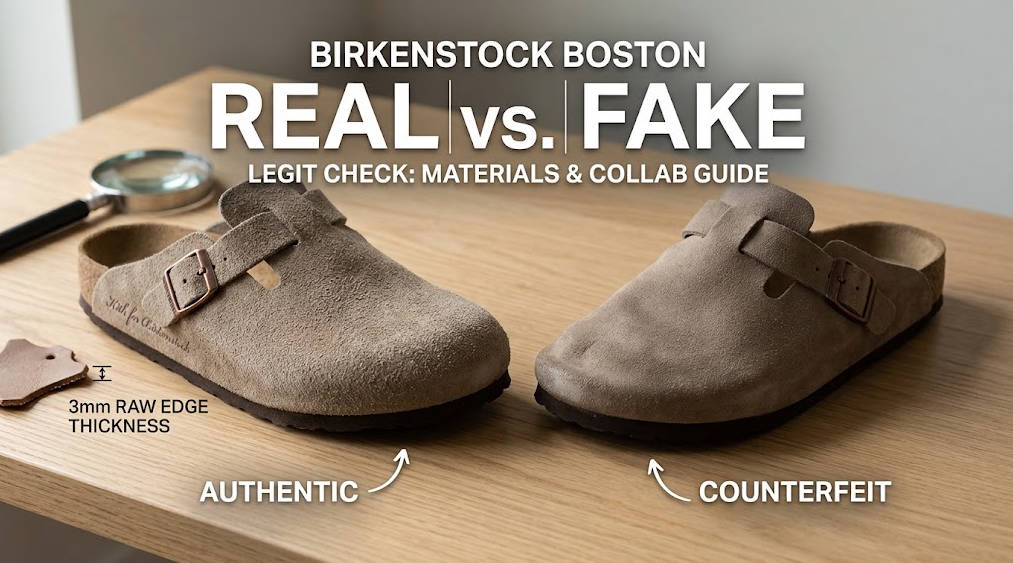
The Era of the "Super-Fake" Clog
The Birkenstock Boston (specifically in the ultra-popular Taupe Suede colorway) successfully transitioned from a niche orthopedic comfort shoe to a global streetwear and high-fashion staple. Its enduring popularity has led to massive, perpetual sell-outs.
However, because the Boston’s design is seemingly "simple"—relying heavily on raw materials like cork, suede, and an EVA sole rather than complex stitching or futuristic tech—counterfeit factories have flooded the secondary market in 2026 with highly accurate replicas.
Authenticating the Boston model today requires moving past a simple logo check. You must scrutinize the structural integrity of the shoe: the density of the cork, the thickness of the suede, and the precise orthopedic anatomy of the footbed. This 10-point guide breaks down exactly how to separate a genuine 2026 retail pair from a high-tier fake.
The Birkenstock Boston at a Glance (2026 Specs)
Before analyzing the microscopic flaws of a counterfeit, you must understand the official specifications of an authentic pair. Knowing these baseline facts will immediately help you spot glaring errors on fake boxes and listings.
| 📋 Spec / Feature | 📝 Authentic Details & Terminology |
|---|---|
| Silhouette Origin | Introduced in 1979 as a year-round, closed-toe alternative to the iconic Arizona sandal. |
| Manufacturing Origin | Made in Germany. (If a standard Suede/Leather Boston says "Made in China" or anywhere else on the footbed, it is instantly a fake). Note: Some waterproof EVA models are manufactured in other European facilities. |
| Retail Price (2026) | $158 - $160 USD (for standard Suede/Oiled Leather). Note: EVA models are ~$60. Exquisite leather, Shearling, or designer collaborations range from $200 to $500+. |
| The "Hype" Colorway | Taupe Suede. (The undisputed most popular and most heavily counterfeited colorway on the secondary market). |
| Width Options (Crucial) | Comes in two proprietary widths. Regular/Wide (indicated by an open/outlined footprint icon 👣) and Narrow/Medium (indicated by a solid/filled footprint icon 👣). |
| Footbed Types |
Classic Footbed: Firm, unyielding, requires a break-in period, and features black ink text. Soft Footbed: Features an integrated anatomical latex foam layer, and always features blue ink text (plus a "Soft Footbed" stamp). |
| The 4-Layer Anatomy | The sole is not just one block of cork. It consists of: 1. Suede leather lining. 2. Upper jute layer (absorbs moisture). 3. Cork-latex core (the ergonomic heart). 4. Lower jute layer (stabilizes the structure). |
| Hardware | Features a custom-stamped, corrosion-resistant metal buckle attached to a 4-hole adjustable strap. |
| Sizing Format | The primary metric is EU sizing (e.g., 41, 42). The footbed stamps the EU size and the millimeter (mm) length. The box label shows EU, US, and UK conversions. |
The 30-Second Authenticity Checklist
Are you inspecting a pair in person at a thrift store or reviewing a resale listing? Run through this rapid physical filter. If you spot any of these red flags, walk away immediately:
-
🚩 The "Deflated" Suede Flaw: Authentic Boston suede is thick (approx. 3mm) and holds a rigid "dome" shape over the toe box even when empty. Fakes use thin, flimsy suede that collapses flat like a deflated balloon under its own weight.
-
🚩 The Mushy Footbed & Missing Toe Bar: Reach inside and press your thumb into the ridge under the toes and the heel cup. Authentic Birkenstocks are notoriously stiff and feature a highly raised toe bar. Fakes are instantly mushy, flat, and offer zero orthopedic resistance.
-
🚩 The Shiny Hardware Flaw: Authentic metal buckles have a subtle, brushed, matte, or oxidized finish. Fake buckles frequently look like cheap, highly reflective chrome or polished aluminum.
-
🚩 The Dry Cork Composite: Genuine Birkenstock cork is visibly sealed with a layer of natural latex, giving it a slight protective sheen and keeping it tightly packed. Fake cork looks bone-dry, matte, and often flakes or crumbles off when rubbed with your thumb.
-
🚩 The Melted EVA Edge: Turn the shoe over and look at the edge of the sole. Authentic EVA tread (the bone/hourglass pattern) features deep geometric cuts that stop sharply at the outer perimeter. On fakes, the tread is incredibly shallow and looks like it's "melting" or stretching unnaturally as it reaches the edge.
Need the full forensic breakdown? Let's dive into the ultimate 10 signs.
The Top 5 Visual & Tactile Signs
Because top-tier fake factories can easily copy the overall shape of the clog, these five micro-details—focusing on material quality and orthopedic tooling—are where they consistently fail.
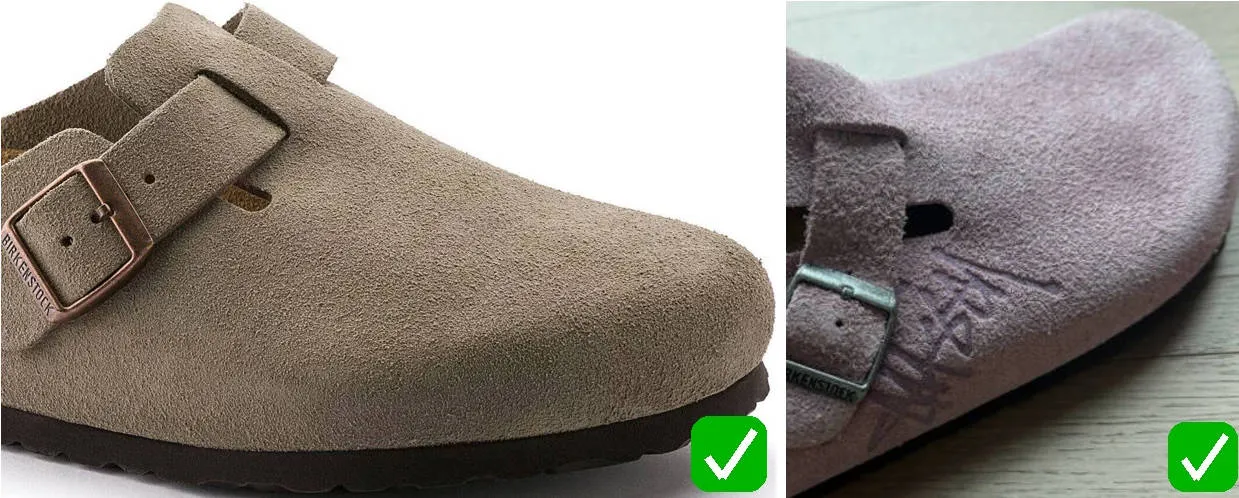
Sign 1: The Suede Thickness & The "Dome" Structure
The Boston is defined by its enclosed toe box. Counterfeiters consistently cut costs by using inferior, heavily processed synthetic suede blends that lack structural integrity.
|
Feature |
✅ Authentic Birkenstock Boston |
❌ Counterfeit (Fake) |
|---|---|---|
|
Toe Box Structure |
The suede is thick, premium, and self-supporting. The toe box forms a distinct, structured "dome" that stays perfectly raised even when your foot is not in the shoe. |
The Deflated Flaw: The suede is dangerously thin. The toe box instantly collapses flat or caves in on itself when the shoe is empty. |
|
Suede "Nap" & Texture |
Features a lively, buttery texture. Brushing your thumb against the grain leaves a distinct, temporary color shift (a stroke mark). |
Feels scratchy, coarse, or like craft felt. It looks completely "dead" and flat under lighting, with no color variation when brushed. |
|
The Edge Cut |
Look at the raw edge of the leather where the strap is cut. Authentic edges are thick, clean, and show the natural fibrous interior of the hide. |
The edge looks artificially sealed, excessively thin, or shows a white fabric backing underneath the suede surface. |
Caption: 📸 Authentic Reference Standard: The Dome Test. Genuine Boston clogs use premium leather thick enough to maintain their iconic rounded shape. Counterfeits frequently use thin materials that collapse instantly.
Sign 2: The Buckle Finish & Engraving Precision
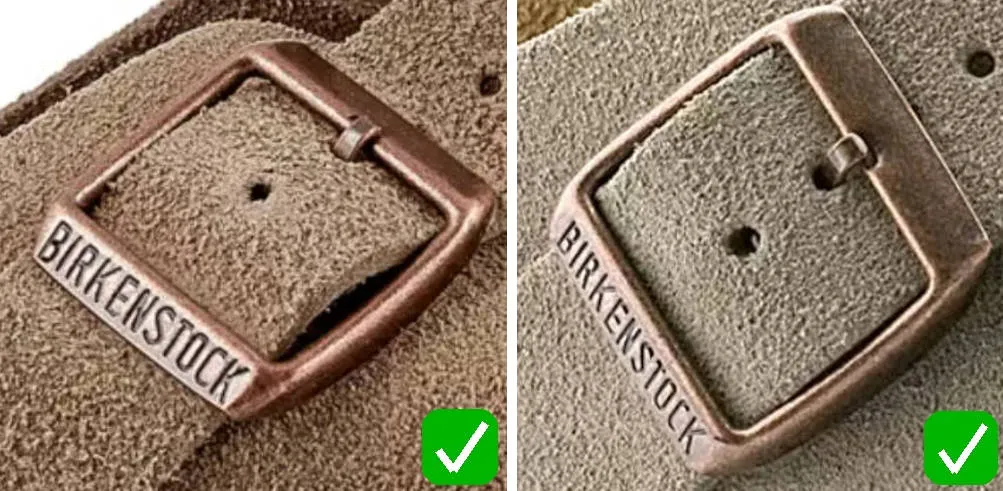
Birkenstock uses proprietary, high-quality hardware designed to withstand years of tension and weather. Fake factories buy generic buckles in bulk and laser-etch the logo.
|
Feature |
✅ Authentic Birkenstock Boston |
❌ Counterfeit (Fake) |
|---|---|---|
|
Metal Finish |
Features a very subtle, brushed, matte, or slightly oxidized/antique finish. It does not blindly reflect light. |
The metal is highly polished, glossy, and excessively shiny, looking like cheap chrome or polished aluminum. |
|
Logo Engraving |
The word "BIRKENSTOCK" is deeply stamped into the metal. The font is crisp, and the interior of the letters has depth. (Note: Very small sizes may just say "BIRK"). |
The text is often superficially laser-etched onto the surface, looking shallow, blurry, or painted on. The letters may be spaced too far apart. |
|
Buckle Prongs |
The prong that goes through the leather hole is thick, sturdy, and blunt at the tip. |
The prong is noticeably thin, flimsy, or overly sharp at the point, easily bending under pressure. |
Caption: 📸 Authentic Reference Standard: The Buckle Finish. Notice the deep stamping and non-reflective, brushed texture of the authentic hardware. Fakes frequently give themselves away with cheap, shiny metal and shallow fonts.
Sign 3: The Footbed Anatomy (The Structural Heart)
This is the most critical functional test. Birkenstock's footbed is a precisely engineered orthopedic device. Fakes just make flat shoes that look like Birkenstocks.
|
Feature |
✅ Authentic Birkenstock Boston |
❌ Counterfeit (Fake) |
|---|---|---|
|
The Heel Cup |
Deeply contoured and rigid. It physically cradles and locks the heel into place. |
The heel cup is remarkably shallow, flat, and offers no lateral support to the heel. |
|
The Toe Bar (Toe Ridge) |
Reach inside and feel under where the toes rest. There is a prominent, aggressively raised horizontal mound that forces your toes to grip when walking. |
The Smooth Flaw: The toe bar is barely noticeable, smoothed out, or entirely missing, feeling just like a standard flat slipper. |
|
Arch Support |
The medial (inner) arch support is dramatically raised and stiff. It will feel initially uncomfortable to an unaccustomed wearer. |
The arch support is soft, mushy, and immediately compresses down to nothing when you apply body weight. |
Caption: 📸 Authentic Reference Standard: The Orthopedic Footbed. Authentic Birkenstocks feature extreme topographical variations—a deep heel cup and a pronounced toe bar. Fakes generally flatten these features out to save on manufacturing complexity.
Sign 4: The Insole Branding & Footprint Stamp
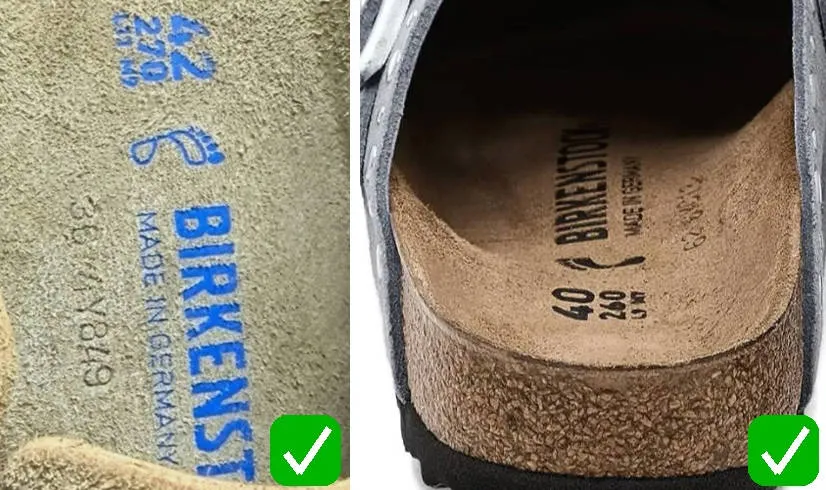
The suede lining of the footbed features specific black typography. Counterfeiters struggle with the alignment and ink application on this textured surface.
|
Feature |
✅ Authentic Birkenstock Boston |
❌ Counterfeit (Fake) |
|---|---|---|
|
Text Alignment & Font |
The "BIRKENSTOCK / Made in Germany" text is perfectly centered. (Note: The Regular footbed uses black ink, while the Soft footbed always uses blue ink). The font weight is clean and highly legible despite the suede texture. |
The text is frequently bolded too heavily, causing the ink to bleed into the suede. The 'e' and 'a' letters may look like solid black dots. |
|
The Footprint Icon |
The footprint indicates the width. Regular width = Open (outlined) footprint. Narrow width = Solid black footprint. The toes on the footprint must be perfectly crisp. |
The lines of the footprint are blurred, or the toes merge together into a single blob. Fakes often mismatch the footprint type with the numerical width code. |
|
The Leather Stamping |
Look at the words "Leder Decksohle" (Leather Insole) or "Brandsole Leather". This text should be deeply and cleanly debossed (pressed) into the suede without black ink. |
The debossing is incredibly shallow, entirely invisible, or illegible. |
Caption: 📸 Authentic Reference Standard: Footbed Typography. Pay close attention to the clarity of the footprint icon and the deep physical debossing of the leather designation (Leder Decksohle). Fakes frequently suffer from heavy ink bleed on the suede.

Sign 5: The Outsole & The "Bone" Pattern
The EVA (Ethylene-Vinyl Acetate) outsole features Birkenstock's proprietary tread. It is a major telltale sign of authenticity when examined at the edges.
|
Feature |
✅ Authentic Birkenstock Boston |
❌ Counterfeit (Fake) |
|---|---|---|
|
The Bone Pattern Depth |
The interlocking hourglass or "bone" pattern features deep, clean, geometric cuts separating each shape. |
The tread depth is incredibly shallow. The bones look melted together, flat, or lack sharp geometric definition. |
|
The Edge Cuts (Crucial) |
Look at where the bone pattern meets the outer edge of the sole. On authentic pairs, the pattern cuts off sharply and cleanly at the exact edge. |
The Warped Edge Flaw: Fakes frequently have a border or a "lip" around the edge of the sole, or the bone shapes warp and stretch unnaturally as they approach the edge. |
|
The Logo Stamping |
The word "Birk" is embossed within the tread pattern at intervals. It is sharp and legible. |
The "Birk" text is entirely missing, upside down relative to the pattern, or completely illegible due to poor molding. |
Caption: 📸 Authentic Reference Standard: The EVA Outsole. Genuine tread is deep and cleanly cut all the way to the edge of the sole. Counterfeit EVA molds are usually low-quality, resulting in shallow tread that warps or melts around the perimeter.
The Secondary 5 Structural & Packaging Checks
If the visual exterior leaves you unsure, you must execute these hidden structural and packaging verifications.
6. The Cork Quality and Latex Sealant Birkenstock's core identity is its cork base. Authentic cork is densely packed and mixed with natural latex. Crucially, the exposed cork on the sides of the shoe is painted with a clear sealant before leaving the factory. This gives the cork a slight sheen and keeps it highly intact. Fake cork composites use cheap glue, look bone-dry (matte), and will literally crumble or flake off if you rub it aggressively with your thumb.
7. The Strap Rivet Placement Look at the large metal rivet/button that attaches the adjustable strap to the main upper of the shoe. On an authentic Boston, the hole punched through the suede is perfectly circular, and the rivet sits flush and tight against the leather. Fakes frequently use dull punch tools, resulting in jagged, messy suede flaps sticking out from underneath the rivet, or the rivet feels loose and can be spun easily with your fingers.
8. The Blue Box Color and Dimensions The traditional Birkenstock box is a very specific shade of deep, matte blue with a subtle crosshatch texture. Fake factories consistently fail to calibrate this color correctly. Counterfeit boxes often appear too pale, possess an aggressive purple hue under natural light, or have a cheap, glossy sheen. Furthermore, fake boxes are frequently crushed upon arrival because they use flimsy, single-ply cardboard instead of rigid corrugated cardboard.
9. The Box Sizing Label (Typography & Barcode) Examine the white sticker on the side of the box.
-
The Silhouette: There should be a small line-art diagram of the Boston shoe. Fakes often use the wrong silhouette (e.g., printing an Arizona sandal diagram on a Boston box).
-
Font Alignment: The conversions for MM, EU, UK, and US sizing must be perfectly aligned in their grids. Fakes often have wandering margins or use the wrong font entirely.
-
The Barcode: In 2026, authentic labels feature incredibly crisp barcode lines. If the barcode looks blurry or "pixelated" around the edges, it was scanned and reprinted by a counterfeiter.
10. The Weight and Flexibility Test Because authentic Birkenstocks use dense cork, thick leather, and rigid jute layers, they possess a surprisingly substantial weight and a stiff profile. Hold the shoe by the toe and the heel and try to bend it in half. An authentic, brand-new Boston will aggressively resist bending. A counterfeit, utilizing cheap craft foam instead of cork and thin synthetic suede, will feel feather-light and can easily be folded or twisted in your hands with minimal effort.
Advanced Legit Check: Material Variations & Grail Collaborations
While the Taupe Suede Boston is the most common target for counterfeiters, the Birkenstock Boston exists in a variety of materials and highly coveted designer collaborations. The standard legit check rules change significantly when you introduce oiled leather, EVA foam, or custom silver hardware.
Here is the definitive 2026 breakdown for authenticating alternative materials and mainstream hype collaborations.
1. The Core Material Matrix: Suede vs. Leather vs. EVA
Counterfeiters use different cheap substitutes depending on the material they are trying to replicate. You must adjust your physical tests accordingly.
2. The Collab Matrix: Authenticating Mainstream Grails
When fashion houses collaborate with Birkenstock, they introduce bespoke hardware and custom stamping. Fake factories struggle to replicate these unique, limited-run details, often mixing them up with standard Birkenstock parts.
Where to Buy Authentic Birkenstock Bostons
The demand for the Birkenstock Boston (particularly the Taupe Suede and designer collaborations) continues to outpace factory production in 2026. This perpetual scarcity makes them a prime target for scammers.
The Golden Rule: There is no such thing as "Factory Direct Wholesale" or a brand new pair of Taupe Bostons for $60. If the price seems too good to be true, it is 100% a counterfeit.
To guarantee your hard-earned money goes toward authentic orthopedic engineering, restrict your purchases to these three verified channels:
1. The Official Source
The absolute safest route is buying directly from the brand, though you may need to sign up for restock notifications for high-demand colors.
-
Birkenstock.com: The official website. Make sure you are on the legitimate regional domain (e.g.,
.comor.co.uk) and not a sponsored Google ad pretending to be Birkenstock. -
Birkenstock Physical Boutiques: Buying in-store allows you to be properly fitted for width (Narrow vs. Regular), which is crucial for the shoe's orthopedic benefits.
-
Birkenstock 1774: For high-end designer collaborations (like Dior or Fear of God), check Birkenstock's premium sub-label, "1774".
2. Authorized Retailers
If the official site is sold out, these vetted, authorized corporate partners are your next safest bet. They source their inventory straight from Birkenstock's German factories.
-
High-End & Department Stores: Nordstrom, Bloomingdale's, and Saks Fifth Avenue.
-
Global Fashion Boutiques: SSENSE, MR PORTER, and END. Clothing.
-
Footwear & Outdoor Specialists: Zappos (excellent return policy) and REI (great for member dividends and trying them on in person).
3. The Secondary Resale Market (For Sold-Out Hype & Collabs)
If you missed a drop or desperately need the sold-out Taupe Suede, you will have to turn to the resale market. In 2026, do not buy via direct P2P transfer (like Instagram DMs or Facebook Marketplace) unless you are an expert at legit-checking. Rely on platforms with strict, physical authentication:
-
eBay (Authenticity Guarantee): The best option in 2026. If a pair of Bostons has the blue "Authenticity Guarantee" checkmark, the seller must ship it to eBay's expert authenticators first. Plus, eBay allows you to see photos of the exact shoe you are buying, so you can check the suede nap yourself.
-
GOAT: Highly recommended, especially if you are open to buying a lightly "Used" pair to save money. GOAT requires sellers to upload photos, and their human authenticators are notoriously strict about the EVA sole and cork quality.
-
StockX: Great for securing brand new (Deadstock) pairs quickly, as they have massive liquidity. However, you cannot see photos of the shoe beforehand, so you must rely entirely on their in-house authentication team.
🚨 Scam Warning: Absolutely avoid buying highly sought-after Birkenstocks from TikTok Shop, independent dropshipping Shopify stores, or heavily discounted Depop/Poshmark listings that use generic, white-background stock photos. These are almost always overseas syndicates shipping "Super-Fakes."
Disclaimer: This guide is for educational purposes only. All trademarks belong to their respective owners. Authentication involves multiple variables, and counterfeit methods are constantly evolving. Use this information as a guide at your own risk.