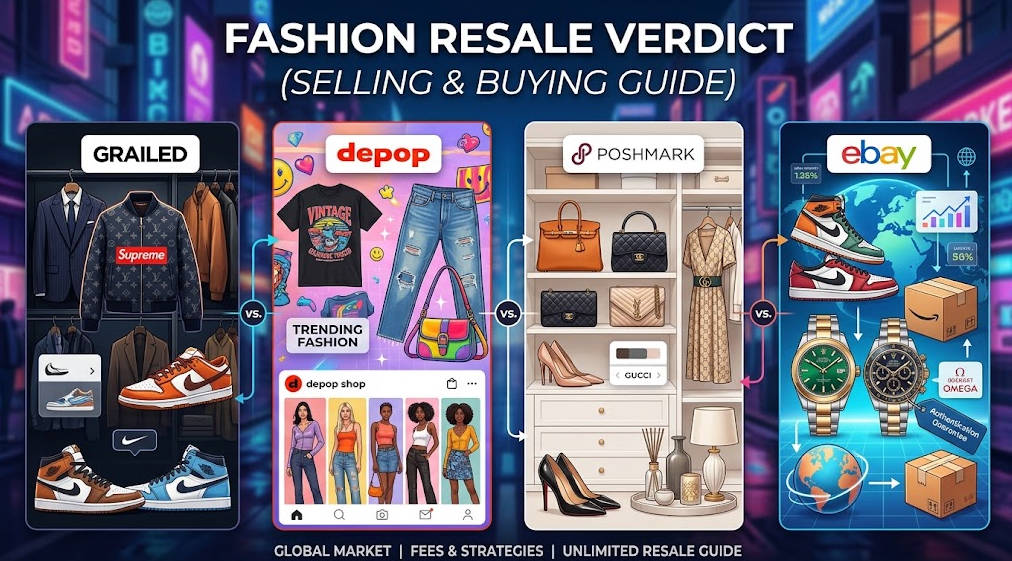
The secondhand clothing market is no longer a niche subculture; in 2026, it is a dominant pillar of global retail. Driven by inflation, a cultural push towards sustainability, and Gen Z's obsession with archive and vintage fashion, platforms that were once considered digital flea markets are now billion-dollar tech ecosystems.
However, for both buyers and sellers, this boom has created a massive paradox of choice. You can no longer just "throw it online." Listing a rare Rick Owens jacket on Poshmark is a recipe for lowball offers, while trying to sell basic Zara sweaters on Grailed will result in zero views. Choosing the wrong platform in 2026 means sacrificing massive profit margins to incorrect fee structures or waiting months for a sale.
This ultimate guide dissects the "Big 4" platforms—Grailed, Depop, Poshmark, and eBay—to help sellers maximize payouts and buyers navigate the treacherous waters of authenticity and algorithms.
The Vibe Check: Who Hangs Out Where?
Before diving into the financial weeds, you need to understand the culture and target demographic of each app. Selling successfully is all about putting your items in front of the right audience.
| 🏷️ Feature | 📈 Grailed | 🛍️ Depop | 👗 Poshmark | 🛒 eBay |
|---|---|---|---|---|
| Target Audience & Vibe | Fashion enthusiasts, hypebeasts, menswear curators. | Gen Z, trend-chasers, Y2K aesthetic lovers. Instagram-meets-resale. | Middle-class millennials, working professionals, everyday consumers. | Global, all ages, serious collectors and bargain hunters alike. |
| Estimated User Base | ~10 Million+ (Highly Niche) | ~35 Million+ (Gen Z Dominated) | ~80 Million+ (Mass Market) | ~130 Million+ (Global Active) |
| Seller Type | C2C & Archive Curators | C2C & Thrift Flippers | C2C & Casual Closet Clearers | Global C2C & Professional B2C |
| Pricing Mechanism | Buy It Now & Binding Offers | Buy It Now & Standard Offers | Buy It Now & Bundle Negotiations | Auctions, Buy It Now & Direct Offers |
| Item Condition | Pristine, Deadstock, High-Quality Used | Heavily Worn to Trendy Vintage | New With Tags (NWT) & Gently Used | The Full Spectrum (NWT to Beaters) |
| Authentication | Rigorous Digital (Photo-based) | Minimal (Community/Report based) | None (Unless >$500 via Posh Authenticate) | Physical (Sneaker Con/Experts for >$200) |
| Fashion Tier | High-End, Hype, Avant-Garde | Trendy Vintage, Fast Fashion | Mid-Tier Contemporary, Mall Brands | The Full Spectrum (Low to Ultra-Luxury) |
| Main Categories | Archive Designer, Premium Streetwear, Vintage Band Tees. | Y2K fashion, 90s Vintage, baggy denim, aesthetic cores. | Lululemon, Zara, everyday women's wear, athleisure. | True Vintage, Luxury Handbags, Watches, deadstock sneakers. |
| 👍 The Good (Pros) | High willingness to pay premium prices for rare items; niche community. | Massive organic traffic for aesthetics; ZERO seller fees in 2026. | Incredibly simple, flat-rate shipping; very loyal community. | Unmatched global reach; eBay Authenticity Guarantee for high-value items. |
| 👎 The Bad (Cons) | Slow sales for basic/mall brands; heavily male-focused. | Heavy lowball culture; requires high-effort styling/photos. | Punishingly high 20% seller fee; requires daily "sharing" grind. | Outdated UI; highest learning curve for listing and SEO. |
The Hard Numbers & Platform Deep Dives
To truly master the 2026 resale market, you need to know exactly where your money is going and how each platform's algorithm works. Let's start with the hard numbers: the fees, the shipping rules, and the return policies.
💰 The 2026 Fees & Logistics Breakdown
|
⚙️ Metric |
📈 Grailed |
🛍️ Depop |
👗 Poshmark |
🛒 eBay |
|---|---|---|---|---|
|
Seller Commission Fee |
9% (Standard). 6% (Reduced rate for items under $120 starting mid-2026). |
0% (In US, UK, AUS). 10% for sellers outside these regions. |
20% flat (Sales $15+). $2.95 flat fee (Sales under $15). |
8% (Sneakers >$150). 13.6% (Most clothing). 15% (Luxury Bags <$2k). |
|
Payment Processing |
~3.49% + $0.49 (Varies slightly based on PayPal/Stripe limits). |
3.3% + $0.45 (For US Depop Payments via Stripe). |
$0 (Completely baked into the 20% commission). |
$0 (Processing is baked into the final value fee + $0.30/$0.40 per order fee). |
|
Buyer Fees |
None (Built into the listing price & shipping). |
~5% Marketplace Fee (Shifted from sellers to buyers in 2026). |
None. |
None. |
|
Shipping Structure |
Seller chooses (Grailed Labels or Own Tracking). |
Seller chooses (Depop USPS Labels or Own Tracking). |
Forced Flat Rate ($7.97 Priority Mail for up to 5 lbs). |
Highly customizable (Calculated, Flat, or Free). |
|
Return Policy |
Strictly No Returns (Unless item is fake/grossly misrepresented). |
Seller's Discretion (Refunds via Depop Protection only for undisclosed flaws). |
3-Day Window (For undisclosed flaws only. No returns for sizing issues). |
Seller's Discretion (But eBay strongly favors buyers in "Item Not As Described" cases). |
|
Payout Speed |
Funds released ~3 days after delivery. |
Funds released 2-3 days after sale (Depop Payments). |
Funds released 3 days after delivery (or buyer acceptance). |
Funds released immediately to bank (Daily/Weekly options). |
🚨 2026 Crucial Shift: The biggest disruption in the current market is Depop. By shifting the marketplace fee onto the buyer and offering 0% commission for the seller, Depop has become the most profitable app for sellers to list low-to-mid-tier vintage. Conversely, Poshmark maintains its punishing 20% fee, effectively charging a premium for its dead-simple shipping labels and massive female user base.
Now that we know the costs, let's look at how to actually succeed on each platform.
1. Grailed (The Curator's Archive)
Originally built as a safe haven for high-fashion menswear, Grailed (now fully integrated into the GOAT Group ecosystem) remains the undisputed king of the "Archive" and streetwear scene. While they have expanded to include womenswear, the core DNA is still rooted in curated, high-end fashion, avant-garde designers (like Rick Owens and Maison Margiela), and premium vintage.
-
The Seller Experience: You are selling to highly educated buyers who care about exact measurements, wash tags, the drape of the fabric, and the historical context of a garment. If you have an Undercover jacket from the AW06 collection, this is the only place to sell it. Sellers must be prepared for the "Binding Offer" system—buyers will constantly send offers below your asking price, but if you accept, the payment processes instantly, eliminating "flakers." Notice their strategic fee update in 2026: offering a reduced 6% fee for items under $120 to capture more mid-tier inventory.
-
The Buyer Experience: It feels like shopping at an exclusive boutique. The search filters are excellent for finding niche designers. Furthermore, Grailed has heavily ramped up its digital authentication, forcing sellers to upload specific tag photos, making it generally safer for buying high-end streetwear than it used to be.
📊 Grailed: Community Consensus
2. Depop (The Gen Z Aesthetic Engine)
Depop operates exactly like an Instagram or TikTok feed. The algorithm does not care about your brand as much as it cares about your aesthetic and your visual presentation. It is the global epicenter for Y2K fashion, 90s nostalgia, and trending TikTok "cores" (e.g., fairy-grunge, blokecore).
-
The Seller Experience: To survive on Depop, a flat lay on a carpet won't cut it. You must model the clothes, use excellent lighting, and stuff your description with aesthetic keywords. The massive shift to 0% seller fees (in the US, UK, and AUS) in 2026 fundamentally changed the game. You keep virtually all your profits, making it the ultimate destination for volume sellers flipping thrifted finds.
-
The Buyer Experience: It is the best place to find curated vintage bundles and hyper-trendy pieces. However, because Depop shifted a ~5% "Marketplace Fee" onto the buyers at checkout, you need to factor that into your budget when making offers. You also have to navigate a lot of "drop-shippers" selling cheap fast-fashion disguised as vintage.
📊 Depop: Community Consensus
3. Poshmark (The Social Wardrobe)
Poshmark is the virtual mall. It thrives on mid-tier, accessible brands and operates on a highly social, gamified algorithm that requires constant engagement. It is the dominant force for everyday women's wear, athleisure, and mall brands.
-
The Seller Experience: The algorithm demands "the grind." To keep your items at the top of search results, you must constantly click "Share" on your listings and attend virtual "Posh Parties." It is exhausting work. However, sellers happily pay the staggering 20% commission fee because Poshmark offers the best shipping system in the world: a flat-rate label that covers up to 5 lbs. You can throw a heavy winter coat and a pair of boots into one box without calculating postage.
-
The Buyer Experience: The "Bundle" feature is elite. Buyers can bundle 3 or 4 items from one seller's closet and negotiate a massive discount, paying only one flat shipping fee. It's the absolute best platform for buying everyday office wear (Zara, Anthropologie) and gym clothes (Lululemon) in bulk.
📊 Poshmark: Community Consensus
4. eBay (The Global Behemoth & The Authenticity Fortress)
Is eBay just for cheap garage sale finds? Absolutely not. In 2026, eBay operates a dual-threat fashion ecosystem that caters to both bargain hunters and elite luxury collectors.
-
The Standard eBay Experience: This remains the ultimate destination for "True Vintage" (e.g., 1980s Levi's 501s, 90s faded Harley Davidson tees). The search engine relies heavily on traditional SEO, meaning your title keywords matter far more than having a trendy photo. Sellers love it because they have total control over shipping options, and their variable fee structure means you often pay significantly less than 20% on standard clothing items (typically 13.6%).
-
The Authenticity Guarantee Experience: For luxury handbags, high-end streetwear, sneakers, and watches, eBay mandates its blue-check Authenticity Guarantee. When a buyer purchases an eligible item, the seller ships it directly to a facility of elite human authenticators. They inspect the item, verify it, attach an NFC tag, and ship it to the buyer. This physical, hands-on process makes eBay the absolute safest platform on the internet for ultra-high-end fashion in 2026.
📊 eBay: Community Consensus
The Seller's Playbook: Where and How Should You List?
In 2026, successful resellers do not just randomly upload clothes; they treat their inventory like a stock portfolio. You must match the garment to the platform's specific audience, fee structure, and shipping rules to maximize your profit margins.
Here is the definitive strategy for sorting your inventory:
1. Match the Garment to the Matrix (The Sorting Scenarios)
-
Scenario A: The Heavy Winter Coat & The Chunky Boots (Dr. Martens, The North Face)
-
👉 Go to Poshmark. Shipping heavy items independently can cost you $15-$25, completely wiping out your profit. Poshmark’s flat-rate label covers up to 5 lbs for under $8. Take the 20% commission hit because the shipping savings will actually net you more money.
-
-
Scenario B: The Thrifted Graphic Tee & Baggy Denim (Y2K, Ed Hardy, Carhartt)
-
👉 Go to Depop. Throw the clothes on, take some edgy mirror selfies in good natural light, and use trending aesthetic hashtags. Take advantage of the 0% commission to keep all your profits. This is a volume game.
-
-
Scenario C: The Hype/Designer Flex (Balenciaga, Chrome Hearts, Stüssy)
-
👉 Go to Grailed or eBay. The Grailed community knows the exact value of these items and won't flinch at a $600 price tag. However, for items over $500, eBay (with Authenticity Guarantee) is the absolute safest backup to ensure you aren't scammed by a fraudulent "Item Not As Described" chargeback, as eBay's physical authenticators take liability once it passes their hub.
-
-
Scenario D: True Vintage & Obscure Finds (1970s Leather Jackets, Single Stitch Tees)
-
👉 Go to eBay. Depop teens won't appreciate the historical value (or the premium price tag) of a true 1980s Levi's 501 redline. eBay's global search engine puts your item in front of wealthy collectors in Japan, the UK, and Europe who hunt using highly specific keywords.
-
2. The Pro-Seller Strategy: Cross-Listing & "The Cascade"
Do not rely on a single algorithm. In 2026, professional sellers use cross-listing software (like Vendoo or List Perfectly) to push one item to all four platforms simultaneously. However, smart sellers use "The Cascade" pricing method:
-
Step 1: List your item on Depop at your ideal target price (since there are zero seller fees, you keep it all).
-
Step 2: List the same item on Grailed slightly higher (to account for the 9% fee and buyers' tendency to lowball).
-
Step 3: List it on Poshmark at a 25% markup. Why? Because Poshmark culture requires you to send 10-20% discount offers to "likers" to trigger a sale, and you need to absorb the massive 20% platform fee without losing your shirt.
The Buyer's Playbook: Safety, Hacks, & Negotiation
Buying secondhand online is a battlefield of inflated prices, dropshippers, and terrifyingly accurate "super fakes." Here is how to protect your wallet and score the best deals.
1. The Authenticity Battlefield: Spotting Fakes & Protecting Your Purchase
The replica industry has evolved to produce "Super Fakes." They use identical factory materials, steal legitimate batch codes, and even fake RFID tags. Here is how to navigate the authenticity traps on each platform:
-
The "Stolen Photo" Scam (Grailed & Depop): A scammer will steal photos of an authentic Chrome Hearts hoodie from an old Instagram post and list it. Grailed’s digital AI might pass the photos because the item in the photo is real, but the seller will mail you a fake.
-
The Fix: Always ask for "Tagged Pics." Before buying any hype item, message the seller and ask them to upload a photo of the item with a piece of paper showing their username and today's date written on it. If they refuse, run.
-
-
The Receipt Illusion: In 2026, never trust a receipt as proof of authenticity. Scammers routinely buy one real pair of Balenciaga sneakers, get the physical receipt, and use that same receipt to sell 50 counterfeit pairs. Ignore the receipt; authenticate the physical item (especially the inside wash tags, which fakes often get wrong).
-
Beware the "Dropshipper" (Depop/Poshmark): If a seller has a vintage graphic tee available in "All Sizes" (S, M, L, XL) and uses suspiciously clean, white-background stock photos, they are likely drop-shipping cheap, low-quality replicas from overseas factories directly to your house.
-
The Authentication Hierarchy:
-
eBay (The Fortress): If you are buying a $1,000 Chanel bag or $800 sneakers, eBay is your safest bet. However, you must ensure the listing specifically has the blue "Authenticity Guarantee" checkmark. If it does, an expert physically inspects the stitching before it reaches you. If it turns out to be fake later, eBay takes the liability.
-
Grailed (The Digital Filter): Uses rigorous digital photo authentication. It keeps 90% of fakes off the platform, but top-tier fakes can sometimes trick a photo scan.
-
Poshmark (The Wild West below $500): Poshmark only physically authenticates items over $500. Anything below that, you are entirely on your own to legit-check.
-
Depop (Zero Protection): Depop has virtually no proactive authentication. You must legit-check the item yourself and rely strictly on PayPal/Depop dispute policies if you get scammed.
-
2. The Negotiation Tactics (How to Haggle in 2026)
-
The "Buyer Fee" Leverage (Depop): Since Depop shifted the ~5% marketplace fee onto buyers, use this in your negotiations. If a shirt is listed for $50, message the seller: "Hey, with the new buyer fee and shipping, this comes out to $65 for me. Would you accept a $40 offer?" Since the seller pays zero fees, they are highly likely to accept.
-
The "Bundle" Hack (Poshmark): Never buy a single $15 basic shirt on Poshmark; the $8 flat shipping ruins the deal. Always check the seller's entire closet. Add 3 or 4 items to a "Bundle" and send a lowball offer for the entire package. Sellers are desperate to clear inventory and will almost always give massive 30-40% discounts on bundles to save on shipping hassle.
-
Respect the "Binding Offer" (Grailed): On Grailed, when you send an offer, your credit card is pre-authorized. If the seller accepts, you are charged instantly. Do not send offers if you aren't ready to buy. Sending an offer of $100 on a $400 jacket won't start a negotiation; it will just get you blocked by the seller.
3. Record Your Unboxings (The Ultimate Insurance)
When buying high-value items, always record a continuous video of yourself opening the package. Show the shipping label clearly, cut the tape on camera, and inspect the item's flaws. If the seller sent you a brick, or an item with undisclosed stains, this video is the only undeniable proof you have to win a PayPal or platform chargeback dispute.
Do not cross-list everything manually; be strategic. (Though using 2026 cross-listing software like Vendoo or ListPerfectly is highly recommended for full-time flippers).
-
Scenario A: The Hype/Designer Flex (Balenciaga, Chrome Hearts, Stüssy).
-
👉 Go to Grailed. The community knows the value of these items and won't flinch at a $600 price tag. For items over $1,000, eBay (with Authenticity Guarantee) is the safest backup to ensure you aren't scammed by a fraudulent chargeback.
-
-
Scenario B: The Thrifted Graphic Tee & Baggy Jeans (Y2K, Carhartt, Ed Hardy).
-
👉 Go to Depop. Throw the clothes on, take some edgy mirror selfies, use the right hashtags, and keep 100% of the commission (minus payment processing).
-
-
Scenario C: The J.Crew Sweaters & Lululemon Leggings.
-
👉 Go to Poshmark. The "Posh" audience actively hunts for premium mall brands for office wear and the gym. Plus, throwing a heavy sweater into a free USPS Priority box with Poshmark's flat-rate label saves you massive shipping headaches.
-
-
Scenario D: True Vintage & Obscure Finds (1970s Leather Jackets, Single Stitch Tees).
-
👉 Go to eBay. Vintage collectors scour eBay globally using highly specific search terms (e.g., "1994 Pink Floyd Tour Shirt Screen Stars Tag L"). Depop kids won't appreciate the history (or the price tag) of true vintage like eBay buyers will.
-
The Final Verdict
There is no single "best" platform in 2026—only the right platform for the specific type of clothing you are holding.
If you want the absolute highest profit margins on fast-moving vintage, the 0% seller fee makes Depop the undisputed champion. If you are cleaning out everyday mall brands and want a completely frictionless shipping experience, bite the bullet and pay Poshmark's 20%. For selling exclusive archive menswear and streetwear to people who actually understand its worth, curate a beautiful Grailed page. And for serious true vintage, luxury grails, and unshakeable buyer protection, trust the global reach and physical authentication of eBay.
Stop treating them like identical marketplaces. Sort your closet, pick your platform, and start listing.